May 27, 2013

A Trip to the Gulf Coast...

Sunset on Mobile Bay
As I was leaving for work last Thursday Morning, Mary Ann asked, "What would you think about going to Gulf Shores this weekend?"  That started a rapid-fire series of events that led to a really wonderful weekend.  She got on the phone and discovered that most of the hotels on the coast were booked up.  She found a couple of accommodations that were $1,000 per night with a seven-night minimum!  And finally, she found a Courtyard Marriott in Spanish Fort, Alabama, with a room available that we could get using some of my Marriott points.  She called me at work and I told my boss I was planning to take Friday off.  That was how it all started.

We got mostly packed on Thursday night, finished up on Friday morning and were underway by about 11:00 AM, loaded with coolers, baggage, hanging clothes, books and Kindles, shoes and sandals -- prepared for anything shy of a formal ball or presidential inauguration.  We had no trouble finding our location and were in our room around 6:00 PM.


The Original Oyster House
Technology is wonderful and especially nice when in a strange city and in need of a good place to eat.  We turned to Urban Spoon and looked for a good seafood restaurant near our hotel.  If you have this app installed on your iPhone it senses your current location and seeks nearby restaurants first.  One thing I like about Urban Spoon is that it includes ratings by customers and in many cases, the menu of the restaurant under consideration.  We ended up having dinner about 5 miles from our hotel at the Original Oyster House on Battleship Parkway (Highway 90).  We were in the queue waiting for a table when the bar manager came over and said, "I can seat you at the bar right now if you'd like.  Full service."  We accepted his offer and sat at the bar for a truly memorable dinner.  We started with a southern tradition -- fried green tomatoes.  Mary Ann had a sampler dinner of crab claws and shrimp while I had shrimp stuffed with crab in remoulade sauce.  Everything was perfect.  We arrived back at ground zero around 9:30 and crashed.

I arose early on Saturday and let Mary Ann sleep in.  I went to the lobby with my Kindle

"Father Bob" preparing
to hear confessions
(another marvel of technology) and read for about an hour and then brought some coffee to the room.  We discussed our plans for the day and decided to focus on Bellingrath Gardens and Home, a place I had visited briefly about 40 years ago.  Once more, I got into the Urban Spoon application to see where we might have lunch on the way.  I chose a place called "Spot of Tea" described as "in beautiful downtown Mobile, Alabama, across from Cathedral Square at 310 Dauphin Street.  This Historical landmark is located within the Lower Dauphin Street Commercial Historic District, which was listed on the National Register of Historic Places in 1979."  This sounded interesting, the menu looked intriguing, and I thought it might be a chance to visit the Catholic Basilica Cathedral of the Immaculate Conception, a magnificent church completed in 1850.

The Cathedral interior -- Breathtaking!
We were not disappointed.  We found a parking place rather easily.  The old town neighborhood was charming with walkers and bicyclists everywhere, a concert of brass band music going on in the park, and the absolutely perfect weather.  We had a great lunch -- Mary Ann had a "Manhattan Reuben" sandwich, while I had "Eggs Cathedral" consisting of scrambled eggs served over a crab cake on toast with Hollandaise sauce.  After this "light" meal, we needed to walk, so we proceeded to the cathedral, which was open for visitors.  It's a spectacularly beautiful building, well worth a visit.  It's interesting to ponder on all the history that this building has witnessed -- from the age of slavery to the atomic age.  And also to consider all the severe weather events it has survived.  It was obviously built to last.


We left downtown Mobile and found our way to Bellingrath Gardens, which are on the western side of Mobile near the town of Theodore, Alabama.  The tour here takes you through the gardens, which cover some 16 acres, and through the home in which the Bellingraths spent much of their married life.  Mr. Bellingrath made his fortune as one of the earliest franchisees of the Coca Cola bottling empire.  Mrs. Bellingrath was the inspiration behind the gardens, the home, and the remarkable collection of antiques that furnish the home.  As an example, the enormous dining room table was formerly owned by Sir Thomas Lipton, the British tea baron.  There were eight different complete settings of china in the butler's pantry.  The silver serving pieces were beyond description.  And the gardens must be experienced to be believed.  As we were proceeding through the gardens, we encountered a busload of British and Australian tourists who were on a coast-to-coast excursion.  They were as impressed as we were.  We highly recommend this attraction.


I suggested that we try to find a place to eat on the way home.  Again, Urban Spoon came to our rescue.  Based on a high approval rating and several favorable comments, we ended up at Baudean's in Theodore, Alabama.  It's not impressive on the outside, but our meal was delightful.  I wrote a very favorable review for a site called Trip Advisor, another of my favorite rating sites.  We each had a small portion of broiled shrimp with a side salad and baked potato.  The food was fresh, well prepared, nicely served, and delicious.  We were overfull on the small portion.  I'd hate to see what the large portion looks like!
We made it back to our hotel and retired for the night.  After awakening on Sunday, we enjoyed a little coffee, got ready to go forth. and had lunch at a nearby Japanese hibachi restaurant, Japanese Express.  The grilled food -- Mary Ann had shrimp/beef combo, I had scallops --was perfectly cooked and served over a bed of rice with a pungent sauce.  The side servings of steamed vegetables were nicely done and still firm.  The side salads were ultra fresh and cold.  We lucked out again.  Then we headed for today's first tourist activity, the USS Alabama and its associated attractions, an aviation museum and a World War II submarine, the USS Drum.  The drive across the bay took no time and before we knew it we were parking the car within a couple hundred feet of this beautiful fighting machine.  It's a majestic example of a bygone era when giant ships slugged it out with enormous guns at ranges in excess of twenty miles.
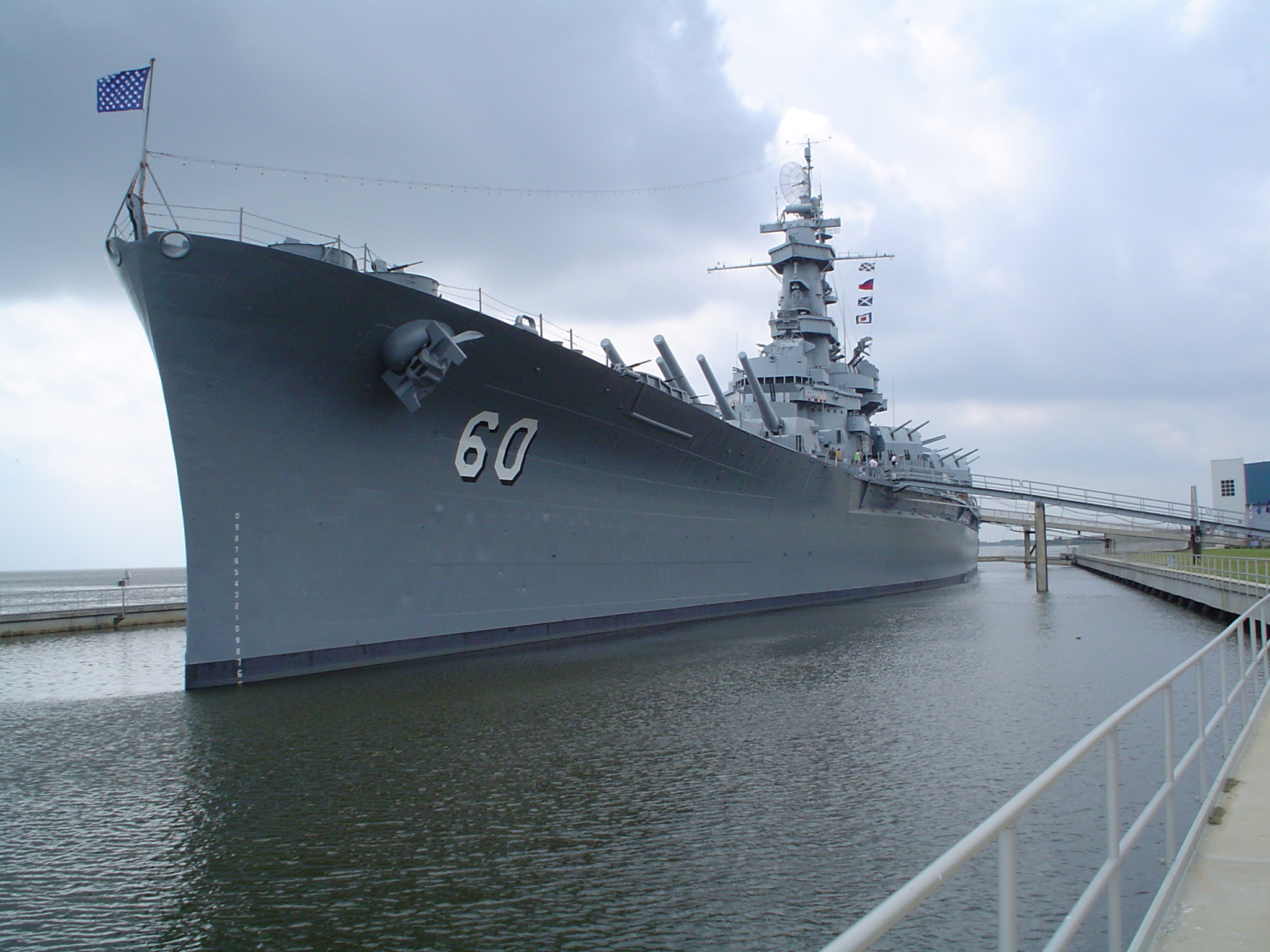
According to Wikipedia, "USS Alabama (BB-60), a South Dakota-class battleship, was the sixth ship of the United States Navy named after the US state of Alabama,   Alabama was commissioned in 1942 and served in World War II in the Atlantic and Pacific theaters. She was decommissioned in 1947 and assigned to the reserve duty. She was retired in 1962. In 1964, Alabama was taken to Mobile Bay and opened as a museum ship the following year. The ship was added to the National Historic Landmark registry in 1986."  She displaces around 35,000 tons.  (Compare this with the displacement of 2,250 tons for my first ship, the USS Hugh Purvis, a destroyer.)  The Alabama is just shy of 700 feet log and has a beam of about 100 feet.  To a former destroyer sailor, it seems really HUGE.

Mary Ann and I paid our entry fee to the park and proceeded up a ramp to the main deck, still covered with teak, as it was built.  We entered the superstructure and Mary Ann decided she would remain above the main deck while I explored.  I descended about four decks in the aft part of the ship and saw huge crew bunking areas as well as the service spaces that were needed to care for her 1,800 officers and crew.  There was a large barber shop, a tailor shop, and even a cobbler's shop.  The brig had for separate cells.  The bakery and food preparation areas were enormous.  The presentation was beautifully done, with arrows pointing in the direction of self-guided tours, mannikins dressed as crew members carrying out their duties, and an abundance of explanatory plaques and museum displays.
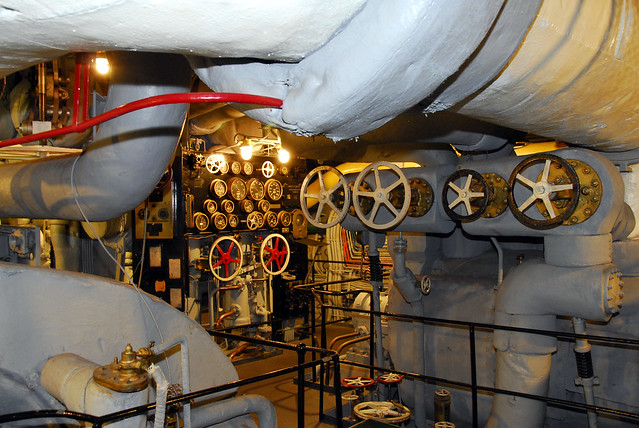
The engine room main control panel
After I "did" the stern tour, I tackled the midships tour which included the engine rooms.  On this class of ship, there is an armor deck that appeared to be two or three inches thick that was a couple of decks below the main deck and was meant to protect the delicate machinery below.  There were gyroscopes for guiding the ship and enormous mechanical "computers" to solve the equations of trajectories used in guiding the giant gun turrets.  I walked through all these spaces on the third and fourth decks below the main deck before I saw the signs indicating another ladder would take me down into an engine room.

My interest in this aspect of the ship stems from the fact that I was Main Propulsion Assistant on a destroyer and later the Chief Engineer of a destroyer escort, the USS Maloy.  I love ship's machinery!  I was not disappointed.  The engine rooms are very much intact and available to visitors.  I simply had to take a picture of this ID plate on a ship's generator cooling coil made in my home town of Schenectady, N.Y.


After I got my fill of below decks exploring, I rejoined Mary Ann, relaxing in the air-conditioned comfort of the officer's wardroom (dining room to you landlubbers).  We proceeded to the aviation museum near the battleship.  I half-seriously said to Mary Ann, "Maybe we'll see an F-8 Crusader like my brother flew."  Sure enough, in a very nice collection of well-preserved military aircraft, there was an F-8.  My brother Bill logged over 2,000 hours in that type of airplane.

The Chance-Vought F-8 "Crusader" - The plane my brother flew in the 1960's
After seeing the aircraft, I left Mary Ann once more to visit the USS Drum (SS-228), a Gato-class submarine with a distinguished war record.  Again, according to Wikipedia, "Drum was the twelfth of the Gato class but was the first completed and the first to enter combat in World War II. She is the oldest of her class still in existence."  I had some previous experience riding a diesel-powered submarine.  This tour, walking from the forward torpedo room to the aft torpedo room, brought back a flood of memories and reminded me of the sacrifices made by the submariners in World War II.

Interior of USS Drum - Tight Quarters!
We left the Battleship Park and drove to Foley, Alabama to the Tangiers Outlet Mall.  Thank God for GPS!  We found the place with no trouble, shopped for a little while, found a nice shirt for yours truly at Brooks Brothers, and headed home.  I suggested we find a place to eat at between Foley and Spanish Fort.  We ended up at Champy's Fried Chicken in Daphne and hit another home run.  Does this entry sound like an eat-a-thon?  We arrived back at the hotel by about 6:30 PM, tired but having enjoyed a wonderful day.

Monday morning, we got packed and dressed and proceeded for a late breakfast at a nearby IHOP.  When we left Spanish Fort, the GPS said we'd be home by 6:42 PM.  We made a few convenience stops and one stop for fuel.  Picked up a dinner pizza in Huntsville, and were still at the house right around 7:00.  We were tired but happy.  It was a most relaxing and enjoyable getaway.

May 19, 2013

Banjo Boys, Chapter 19

This weekend, both Monty and Clint had previous engagements, so I was on my own.  The big news this week was that the clear plastic heads for my banjo and Monty's arrived.  We ordered these a few months ago but because of their non-standard size (11-5/8", medium crown), they had to be custom made.

The first job for this weekend was to re-fabricate my tension hoop -- the hoop that is pulled down by all those hooks and stretches the head across the rim.  I had already made this hoop, but I made it slightly too small.  I bought some more brass to start over.  I now have the advantage of having the head to use as the gauge for the size of the hoop.  So the first thing I did on Saturday was to fabricate this ring and prepare it for Dan Shady to silver solder the ends together.  The ends are cut at an angle as shown to provide a larger surface for the silver solder to adhere to.

As soon as I laid my plastic head in place, I realized that I had a problem.  The gap that exists between the Rim and the base of the neck, intended to accommodate the hoop of the head, was too narrow.  The edge of the head couldn't slip down into the gap.  So I knew that the second job for the weekend was to somehow widen that space.
I removed the neck from the rim.  I then drilled a small hole in the dowel rod at exactly the midpoint of the rim (5 13/16" from the base of the neck).  This gave me a pivot point from which I needed to deepen the radiused cut that already existed in the bottom of the fretboard.  I clamped a board on my drill press that had a nail of the proper diameter to fit in the newly-drilled hole.  I then mounted a small sanding drum in the drill press, adjusted the board so that the sanding drum would take a thin slice from the existing arc and swung the neck back and forth across the abrasive surface.  I had to repeat this a couple more times, readjusting the position of the board each time.  I finally dressed up the bottom edge of the cutout area with some precision chisels.  Then I stained the newly-exposed surfaces to match the rest of the neck.  I think the result speaks for itself:


So now, I have a banjo with a clear plastic head in need of a tension hoop, to be completed this week.  I also need to figure out exactly how I'm going to use my Navy spoons as tension hooks and how I'm going to make the tailpiece out of the meat fork.  We're getting close!

May 5, 2013

Banjo Boys, Chapter 18

My polished rim with polished brackets (Courtesy of Monty)

Last week there was no report on Banjo Boy activities.  The Meads made their annual pilgrimage to Merlefest.  This has been a part of Mead family music life for 24 years!  Coincidentally, it was Monty Love who first told me about this music festival celebrating the life of the late Eddie Merle Watson, son of the now-deceased Arthel "Doc" Watson.  Doc died last year at 89, the result of a fall at his home.  He was praised and remembered by all at this year's festival.  We can only hope that one day the three banjos that result from our Banjo Boy effort somehow make it to Merlefest.

Yesterday, Monty came up.  Clint, being the loyal son that he is, went to Cleveland, Tennessee, to visit his parents.  Our goals were simple: 1) Complete the installation of Monty's fifth string tuning peg, 2) Get his nut rough shaped and fitted, 3) Start the process of polishing Monty's rim, and 4) Get my brass brackets completed for the outside of the rim.
Monty's fifth string peg and hole for nut
It was already raining when Monty got here, so we didn't move the Plymouth outside.  We began by setting up the jig that Clint and I had used to drill and ream our fifth string peg holes.  After a brief discussion on exactly where to drill the guide hole, we clamped Monty's neck to the jig, positioned it under the 1/2" square-cut drill bit, and drilled into that beautifully finished maple.  It went just as planned.  After a few minutes of trial-and-error reaming, Monty asked if I thought he had gone deep enough.  It looked just right to me, so he set up our home made pressing jig and clamped the tuning peg firmly in its hole.  It looks perfect.  He then went on to drill the tiny hole that will hold the fifth string nut.  The results speak for themselves.

Polishing a bracket
I spent an hour or so tapping the threads in the mounting holes that attach the brackets to the rim.  This is tedious work, requiring that the tap be aligned precisely with the hole that has already been drilled.  Fortunately, I was able to tap all the threads without having to discard any of the blanks.  These brass brackets require a remarkable amount of labor to go from brass blank to polished finished product.  But when they are finished, they sure are pretty to look at, especially reflected against the aluminum rim.

We broke for lunch at Honey's Restaurant, "Home of the Slawburger," after which it was back to the shop.  Monty worked upstairs, sanding his rim with ever-finer grades of sandpaper, while I polished brass brackets downstairs, making a real mess of lint and polishing compound on my drill press and workbench.

Monty's nut and beautiful Peg Head
I spoke with Bob Smakula this week, the fellow from whom Monty and I are buying our clear plastic heads (We want everybody to be able to see the turbine blades in the Dynaflow rim).  It looks like they'll be here in a couple of weeks.  I still have to figure out how I'm going to configure my Navy spoons to make the 16 clamps that go around the perimeter of the rim.  And I also need to determine how to make my tailpiece from the meat serving fork that I bought on eBay.  Even so, the end is in sight...

More to follow.

Monty's rim, ready for final polishing

Apr 29, 2013

Merlefest 2013...


Overhead view of the Main Stage area.  We are in row 28 on the lower left in this image.

The late, great Doc Watson
As I've posted many times before, Merlefest is a marvelous celebration of Americana and "Roots Music" that takes place in North Wilkesboro, North Carolina every April.  It was established to celebrate the life and music of Merle Watson, son of legendary guitarist and singer Arthel "Doc" Watson, who passed away last year.  This was my 24th Merlefest and would be the first without Doc's inspiring presence.  The weather man was predicting a wet weekend, but Mary Ann and I left on Thursday prepared for any kind of weather.

For the last 22 years, the Mead entourage had stayed at the Red Carpet Inn in North Wilkesboro.  It was conveniently located near Wilkes Community College, the venue for the festival.  But each year, the motel became less attractive and more expensive.  This year we decided to break with tradition and stay in Boone, about 35 miles from the festival, and commute each day.  We were in a brand new Courtyard Marriott -- clean, bright, fresh, and free of mold.  Hooray!


After we arrived Thursday evening we drove to Wilkesboro and reserved a parking place for the weekend at a parking venue just outside the entry gate.  This way, even if we got a late start in the morning, we'd have a convenient place to launch our daily expedition.  We then proceeded to Amalfi's, a local Italian restaurant that we had discovered a couple years ago and are very fond of.  After a pleasant, liesurely dinner, we returned to Boone for a great night's sleep.

The Hillside Stage, one of many venues

The Courtyard chain has forged an alliance with Starbuck's Coffee, so first thing after I awoke, I went to the lobby and got two cups of strong coffee to get us started.  We got ready and proceeded to the festival, got our wristbands and went to our reserved seats near the main stage.  Because of the size of the festival, there are nine active stages and venues.  Each act or performer rotates through various performance venues over the four-day course of the event.  They might appear on the main stage one night, then be in the dance pavilion the next day, and then lead a workshop at a different location at another time.  The whole thing is very carefully choreographed and seems to go off like clockwork.


We always see new acts that surprise us.  This year, we discovered Scythian (an upbeat band with a Celtic flair), Della Mae (a terrifically energetic all-girl band), and Matraca Berg (a very talented songwriter from Nashville).  Ms. Berg inspired the audience with a description of a charity she was involved in, Magdeline House, that helps prostitutes proceed out of their unfortunate lives.

Della Mae
We stayed until after 10:00 PM on Friday, making sure we heard a couple of numbers from Government Mule before we left.  It was already drizzling when we arrived on Saturday, so we tended toward indoor venues -- the Old-Time Tent and the Walker Center Auditorium.  We stayed until a little after five, at which point it was raining pretty steadily.  As we were leaving the Walker Center, I turned to two young ladies and asked them if they had tickets to the "Midnight Jam."  They didn't have tickets.  I told them it was their lucky day and gave them our tickets.  The Midnight Jam is a limited admission musical free-for-all that is a great experience, but we had already decided not to go.  We were glad to see that someone could use our tickets.

On Sunday, we slept in.  We had wanted to hear some of the Sunday acts, especially the Avett Brothers, but it was raining cats and dogs.  We decided to have a liesurely lunch and take a little tour on the Blue Ridge Parkway.  One of the hotel staff recommented Coyote Kitchen.  We found it and had a wonderful lunch.  Then it was on to the Parkway for a few miles to the Cone House Visitor's Center and Craft Center.  We went a few more miles after enjoying the Cone House, but the fog was too thick to see any vistas, so we decided to descend on an access road and head home via Elizabethton and Knoxville.


Although we didn't witness as much music as we have at some previous Merlefests, it was still a relaxing and enjoyable music weekend.

Apr 21, 2013

Banjo Boys, Chapter 17

Clint had completed nearly everything as we started today's work.

Today was going to be very special.  As we started the day at Hardee's in Meridianville, Clint and I anticipated the COMPLETION of his banjo.  All that remained for him to complete was finishing his nut (the bone at the top of the fretboard with grooves in it to control the string position), installing the fifth string tuner, a separate nut for the fifth string, and to install strings.  I could almost hear the music.

When we arrived at the shop, Clint started working on his nut.  He had to craft a small wedge-shaped piece of ebony to fit under the nut and glue that in place to create a straight surface to support the nut.  Then he crafted and carefully shaped the nut and glued it in place.  In the meantime, I was installing my fifth string tuner.  This tuner has a tapered shape that is pressed into a tapered recess in the side of the neck.

The tapered reamer

I first made a jig to hold the neck rigidly in place while I drilled a hole into the side of the neck.  Then I began reaming out the hole and enlarging it using a special tapered reamer.  After several trial-and-error test fittings, I felt that the hole was ready.  I then removed the knob from the tuning peg, placed a piece of wood over the tuner body, protected the neck with a soft rag, and used a screw clamp to carefully press the tuner into the recessed hole.  The pucker factor was high.  Did I have the hole large enough or too large?  Would I split the wood?  Was the hole in the right position?  The end result was just fine.


My fifth string tuner and nut (the little white spot)
I finished my tuning peg installation just in time for us to start on Clint's.  His installation also proceeded just fine.  We also drilled tiny holes to install the individual nut that positions the fifth string relative to the other, longer strings.  I had purchased a small white nut and Clint made his out of ebony.

We had lunch at Honey's Pool Hall and Diner in Fayetteville (home of the original slawburger).  Then began the next step in Clint's progress -- installing strings.  I showed Clint how to groove his nut for the strings and how to wind the strings on his tuners.  

I proceeded to work on the remaining brackets that are needed to complete my "pot."  As you may recall, Monty had made all his brackets out of brass stock and even gave me 8 finished brackets to get me started.  I had to drill and tap several of mine and also to polish them.  This is a tedious job.  To hold the bracket while polishing it, I made a handle with a long screw that cinches the raw brass bracket against the wood of the handle:

The polishing handle
Soon. I started to hear notes coming from upstairs, where Clint was installing strings. Then I heard the telltale "pop" of a breaking string!  And I had left our other sets of strings at my office.  Clint only broke one more before he decided to leave well enough alone.

So here's our status:  Monty and I are waiting for clear plastic heads for our banjos.  Estimated delivery is sometime in May.  Clint has a three-string banjo.  Our plan is to visit a banjo player this week to discuss nut design and breaking strings and other setup issues.  I will continue to work on my brackets and associated attachment hardware during the coming weeks.  We're close!

Apr 7, 2013

Banjo Boys, Chapter 16

Even though I've been out of town and the Banjo Boys haven't convened in a couple of weeks, there has been progress worth reporting.  Monty has proceed to apply his tung oil to finish the wood of his neck.  The results are beautiful:

Monty has also crafted his tension hooks out of spoons, and they are ready to install.  He very cleverly drilled and tapped holes in a tab that he bent in the end of each spoon.  This enables him to use screws going through the brackets, rather than threaded rods and nuts, to control the tension on his head.  We now have to wait for the head to arrive.  The original estimate was May.

The spoon-made hooks, ready to install
My rim with brackets (Courtesy of Monty)
I've done very little to my banjo since our last update, as I've been working in Texas.  Last weekend, I did shape my tension hoop and deliver it to Dan Shady.  I also attached the first 8 brackets to the rim, courtesy of Monty Love, who gave me these finished brackets when he decided to use 16 in lieu of 24 on his banjo.  I was in the process of making the remaining brackets when I broke a drill bit and didn't have a spare.  So I have yet to complete,  polish, and install my remaining brackets.

In the meantime, Clint has been proceeding as well.  Both Clint and I finally got around to shaping our tension hoops and took them to Dan Shady to get them silver soldered.  We picked them up on Friday.  Clint had decided to have his rim powder coated in a semi-gloss black finish.  He was notified on Friday that it was ready, and he picked it up.  It looks great:
That wasn't enough.  The pressure was too great.  The neck was finished, the rim was finished, the hardware was all ready, the tension hoop and flesh hoops were now available, and Clint had bought the goatskin to make a banjo head.  The temptation was too much.  So on Saturday, April 6, 2013, Clint followed the directions he had found on the internet, carefully soaked the leather, made the head and assembled his first banjo.  He has ordered strings, but if I were a betting man, I'd bet he'll buy some at a local music store before the mail-order ones arrive.  I don't think he'll be able to wait.  I know I couldn't if I had this beautiful instrument this close to being playable.

Mule Day!

The Spirit of "Mule Day"
This past week, the city of Columbia, Tennessee, celebrated "Mule Day."  “Mule Day” has been a popular Columbia tradition for nearly 170 years, since the 1840s.  It began as “Breeder’s Day”, a single day livestock show and mule market event held on the first Monday in April.  Over time, “Mule Day” evolved from a single day event into a multi-day festival, attracting thousands of attendees, lasting almost a week.  The heavy involvement of Maury County in the mule industry has caused the event to grow over time into “one of the largest livestock markets in the world.”

Mary Ann and I had selected Mule Day as an event we wanted to attend "one of these years."  This turned out to be the year.  We arose early and did our household chores and got ready to leave home around 11:00 AM.  We had read that Saturday was full of exciting events -- the Mule Pull at noon, followed by the Skillington Draft Mule Show at 2:00 PM.  And of course, there was the possibility of seeing the Mule Queen and her court sometime during the festivities.

Lined up for the beauty pageant...
We headed over to Interstate 65 and turned north.  About 20 miles south of Lewisburg, everything came to a stop.  I can only assume that there had been some kind of serious conflagration ahead, as there was no evidence of southbound traffic.  Something had all four lanes blocked.  I was able to get off at an exit ramp a couple of miles up the road, on highway 373, which took us through Mooresville and Culleoka en route to Columbia.  We followed the sizable crowd to the city park adjacent to the fairgrounds at which most of the events take place.  A short hike later, we were in mule owners' heaven!

There are lots of mules (and horses) at this event -- mule wagons, individual mules being led and ridden.  You have to keep an eye out for mule traffic as well as motor vehicles.  After a few minutes getting oriented, we found the entrance gate and found the center of the junk-food universe!  Fried anything, funnel cakes, kettle corn, and beverages that Mayor Bloomberg wouldn't approve of.  We found a Cajun food trailer and enjoyed a lunch of red beans, rice and Cajun sausage (you don't want to know how it's made...).


Then it was off to the Skillington mule arena, where we saw a number of mules being tethered in preparation for the class judging.  It was a great place for peple watching as well as observing the festivities,  At this point, it was about 70 degrees, partly cloudy, with a gentle southern

breeze -- perfect!  At 2:00 PM promptly, the judging began.  The announcer would call for the class and the animals would be led to the judging area in front of the bleachers -- Jack (the father of the Mule) and Jennet classes first, graduating to the Draft Horses (the mother of the Mule).

After the first couple of classes had been judged, we were treated to the arrival of the Mule Queen and her court.  They proceeded to be seated in the judges' pavilion in the center of the arena.

The 2012 Queen and her court
After a couple hours here, we decided to meander toward the parking area.  We stopped to get a tee shirt for a friend and a button to make a refrigerator magnet, and then walked to the car.  And to bring the day to a relaxing end, we took the slow road home, avoiding the interstate.  You ought to consider going to this event sometime.  It was a lot of fun.