This is a documentary that is well worth watching. It stresses the continuity of old-time music from one generation to the next -- what Mike Seeger referred to as "music from the true vine." Enjoy.

Jul 6, 2013


Jun 27, 2013
Memphis or Bust...
 |
| Believe it or not! This 1955 Ford firetruck is competing in the 2013 Great Race... |
A few weeks ago, Jim Kahrs contacted me regarding the 2013 Great Race. Jim is an old colleague from Oklahoma -- first as a student when I taught in the NROTC unit and later as a roommate -- and we have a common interest in cars and other distractions. The first year I participated in the Great Race, Jim joined the crew in Kansas City and helped Margo with the support vehicle all the way to Boston.
I told Jim that I had actually considered going to Germantown on the 26th of June to watch the cars arrive there en route from Minneapolis to Mobile. That was all it took. Jim informed me that his bride, Sheila, was going to be out of town for a couple of days including the 25th and 26th. It made perfect sense that he'd drive from Athens, Georgia on Wednesday, spend that evening with Mary Ann and me, and then he and I would drive from Fayetteville to Memphis and back in one day, just to see a bunch of old cars and old friends.
 |
| Crowds welcomed nearly 100 cars to Germantown |
On Thursday morning, Mary Ann fed us a nice breakfast and after we showered, we got on the road around 9:30 AM. The shortest route to Memphis from our house is actually highway 72 from Huntsville through Decatur, Alabama to Corinth, Mississippi, and on to Collierville, Tennessee. Our first stop in Memphis was directly across the street from the famed Peabody Hotel at a very established rib joint, the Rendezvous. We descended the steps from street level to the subterranean dining room and were greeted by the most amazing aroma. A delicious Memphis-style barbecue rib dinner ensued.
 |
| The local Cobra Club was well represented |
Jim and I proceeded to Germantown (thank God for GPS) and got a good parking place close to the arrival location at Municipal Park. The venue was perfect for a Great Race arrival, with a lovely shaded park adjacent to a wide boulevard for the arrival pageantry. A Great Race stop is a mix of circus parade, carnival barking, high drama, and old cars. A large inflated gate is set up under which the cars pass. Music is blaring over some loudspeakers. A professional sports announcer, Mr. Brian Goudge, of Ottawa, Canada (affectionately know to all as "Motormouth"), announces each arrival, along with some information about car, driver, and navigator. Corky Coker of Coker Tires in Chattanooga is right by Brian's side offering an equally upbeat commentary. The cars and drivers roll by among a cheering crowd. Local sponsors are providing each team with gifts, including cold, wet towels to put around their overheated necks. It all makes for terrific theater.
 |
| Each car welcomed some wet, cold towels for the long-suffering crew |
Jim and I admired the cars and chatted with participants for an hour or so before heading home. We got dinner at a small steak house in Corinth, Mississippi, and were back in Fayetteville a little after midnight. It was a fun experience and brought back many happy memories.
Jun 19, 2013
Mr. C. D. Howard...

I first
encountered Mr. C.D. Howard when, in 1978, I found myself in need of obtaining
a general contractor’s license in Huntsville, Alabama. Mr. Howard (Just call me “C.D.”) was a
Huntsville native. He was the
slowest-talking southern gentleman I have ever encountered – one of those folks
with whom you find yourself trying to pull the words out faster. He was the head of the Huntsville Department
of Inspection.
I asked Mr.
Howard how I might go about getting a license and he advised me of the
necessary steps. But he also stressed to
me the importance of working with his inspectors in the course of a
building project. I took that message to
heart. During the next few years as a licensed general contractor, I often called his office with questions about a specific regulation or
requirement. I practically memorized the
Southern Building Code and never tried to put anything over on the
inspectors. As a result, Mr. Howard and
I got along just fine.
The conversation
which I remember most vividly took place in early 1979. Margo and I had been talking about buying a
lot and building our own home. I had
been studying solar home designs and had drawn up several ideas for a solar
heated energy-efficient home. I had
heard that some localities prohibited contractors from building their own
residences. The conversation with Mr.
Howard took place on one of my regular visits to his office and went something
like this:
Me: Mr. Howard, is it legal in Madison County for
a contractor to build his own home?
C.D.: (very
slowly) Mr. Mead, neither the city of Huntsville nor the county of Madison has
any prohibition against a licensed general contractor building his own place of
residence. However, should you and Mrs.
Mead elect to do so, I suggest that you include in the cost of the residence
the cost of a divorce.
Enough
said. We never tried to build the house.
I recently
learned that Mr. C.D. Howard is a member of the Huntsville-Madison County
Builders Association Hall of Fame. How
appropriate.
Jun 9, 2013
Banjo Boys, Chapter 20
 |
| The first Banjo-Boy to finish his instrument! Congratulations, Clint! |
 |
| A Land Rover like Clint's |
Today was very special. One of the Banjo Boys might finish a banjo that was started back in November. Clint met me for breakfast and we proceeded to the shop. The first order of business was actually to investigate a problem with the front end of his Land Rover. We solved that issue within an hour and began work on our banjos. Monty couldn't be with us today because of a prior commitment.
Clint successfully removed his existing nut by gently tapping it using a small scrap of wood placed against the fret side of the nut and tapping it gently with a mall hammer. The glue popped and the nut could be lifted out easily. He then carefully measured the width of the neck and cut the piece of water buffalo horn that he had acquired for the new nut. Remember that his banjo has lots of black and dark coloration. The water buffalo horn is very dark and looks wonderful with the ebony surface of the fretboard.
 |
| Clint's finished nut. You may be able to see a little wax on the strings. |
We had acquired a new tool to assist in accurately spacing the notches in the nut, so in no time, Clint had shaped the nut, polished it, glued it in place, and was filing his carefully-spaced string notches. He used a feeler gauge placed under the string and over the first fret to judge where to stop filing on each string. This is tedious work and took a couple of hours to complete. He waxed the notches to help the strings slide more easily when tuning and we were ready to bring his banjo to life for the first time! Pictures and a brief video can do this better than words:


I can't express you what a big deal this is. Clint had never built a musical instrument in his life. He told me that Sarah wanted to learn to play the banjo. I threw out the idea of him building one for her. Never, in my wildest imagination, could I have dreamed that he would build this heirloom-quality work of art. Congratulations to Sarah for receiving such a special gift. All the Banjo Boys hope you will learn to play it, treasure and cherish it for many years to come! And now, Clint wants to build a second one -- this time, with a "bees" theme. Get it? Birds and bees?
 |
| My banjo with clear plastic head and tension hoop in place. |
After the excitement of "first notes," I proceeded to sand my tension hoop with gradually finer grades of sandpaper down to 400 grit. This will make it easier to polish eventually and I wanted to "round off" the square edges of the rim. I then placed the clear plastic head on the rim and the tension hoop over the head to mark the place where each notch will be filed. I marked each with a marker pen and then filed a small groove at each mark. Using a fairly aggressive metal file, I made the first notch to see how wide and deep it would need to be. This required that I cut and bend at least one spoon to see how the hook will engage the notch. Here's one of the spoons, cold-bent using a small metal brake.

I decided to go ahead and cut and bend all sixteen spoons. Unfortunately, I broke three in the process, so now I must find a few more. Ebay to the rescue.

Here is how I plan to use the spoons. On the back of each spoon segment, there will be a silver-soldered nut. I will use a stainless steel screw passing up through the bracket and into the nut on the spoon to apply tension to the head. It might even work.
That's all for this chapter.
Jun 7, 2013
A Visit to the "Power Tour"...

I decided it might be fun to drive my 1932 Plymouth coupe to Chattanooga and back in one day. It's about 125 miles to Chattanooga State Community College, the advertised venue where the cars would arrive. I researched a possible route on which I wouldn't have to get on the interstate. It turns out that there are several no-interstate options. I finally decided to take Highway 431 south to Highway 72, then proceed east as far as New Hope/South Pittsburgh, TN. Just before I might normally get on Interstate 24, I would opt for Tennessee highway 156 leading to Tennessee highway 134. This connects with Georgia route 299 connecting with US highway 11 into Chattanooga. The longest leg, on US highway 72, is about 70 miles. This is a divided 4-lane road, which makes it easy for other motorists to go past my car, which is only capable of 55-60 miles per hour.
 |
| The "Back Roads" Route |
 |
| Winston, ready for the trip |
I started watching the weather about ten days in advance of our trip. It didn't look good. I don't like to drive the Plymouth in the rain unnecessarily because it only has one very ineffective windshield wiper. Unless someone has driven a car with vacuum-operated wipers (typically pre-1955) they can't appreciate how bad they were. Whenever you give the car more gas, i.e., try to accelerate, the windshield wipers slow down or stop! Try going up a hill. You have no wipers. Downhil, they go like crazy -- vwap, vwap, vwap, vwap! You get the picture -- I didn't want to drive the old car if rain was likely.
The day before departure, the weatherman was predicting 60% likelihood of rain. I decided to abandon the idea of driving "Winston" and to drive my truck instead. At about the same time, I heard from Monty that he and Patrick would be unable to go. So now, it would be Clint and me in my truck, but I still wanted to take the back roads to scout out the route for future adventures.
Clint and I met on highway 72 and got underway at around 7:00 AM. We stopped in Scottsboro, AL, and had breakfast at the Huddle House. Then we proceeded on our preplanned route. As we reached the haven of Whiteside, Tennessee, on highway 134, Clint was describing his ancestors who had lived in this community and mentioned that many are buried in the Mt. Aetna cemetery (Clint pronounces it "Mount Etny" in the way he has heard it from his kinfolks.). He pointed out the road that goes to the top of Mt. Aetna, and we did what any red-blooded boys would do -- we headed up the mountain.
 |
| One of the better-preserved tombstones at the Aetna Cemetery, Lizzie Graham, who died in 1890 |
In the late 19th century, this mountain was an active coal mining site. There are layers of coal below the top of the mountain. According to the Nooga.com blogsite, "In 1839, land grants from the state of Tennessee passed ownership of parts of Raccoon Mountain to James A. Whiteside and F.W. Lea. Whiteside joined with Robert Craven
 |
| A 19th-Century etching of Aetna Mountain mining |
Coal mining on Aetna Mountain grew. The coal company built a railroad across the mountain, and inclines were built to haul coal to the bottom of the mountain. Houses were built on and around the mountain, and the Aetna Mountain/Whiteside Mountain School was established. A cemetery on the Marion County section of Aetna Mountain reveals the lives that were led on or near the mountain in the mid-1800s."
We took a few pictures and returned down the mountain, proceeding into Chattanooga and to the Coker Tire Company on Chestnut Street.
 |
| Coker Tire Company Headquarters |
Clint's cousin, Jess Hodenpyle, works at Coker. Also, my friend Jeff Stumb, who is from Huntsville, now works for Corky Coker as the Director of the Great Race, now owned by Coker. We paid a visit to both of them, looked around the Coker site at preparations for the evening's Hot Rod-related festivities, and moved on to the campus of the Chattanooga State Community College.
 |
| A sample of the thousands of cars at CSCC |
This was the perfect site for such a huge event. It's a commuter college, so there are parking lots everywhere. We walked for seemingly miles among thousands of cars that had been driven from Birmingham that day. The quality and variety of cars was overwhelming. My particular interest is traditional hot rods as they might have been built in the late 1950's when I graduated from high school. These typically would be modified cars of the thirties powered by souped up engines no newer than around 1955. There were a few scattered among the participants, but the muscle cars of the '60's and '70's prevailed.
After a couple of hours of gawking, Clint and I headed home along an alternative back road route. We even went within a few hundred yards of his grandfather's home near Guild, Tennessee. We arrived home tired but having enjoyed a great day out -- and we only had a few drops of rain!
May 27, 2013
A Trip to the Gulf Coast...
 |
| Sunset on Mobile Bay |
As I was leaving for work last Thursday Morning, Mary Ann asked, "What would you think about going to Gulf Shores this weekend?" That started a rapid-fire series of events that led to a really wonderful weekend. She got on the phone and discovered that most of the hotels on the coast were booked up. She found a couple of accommodations that were $1,000 per night with a seven-night minimum! And finally, she found a Courtyard Marriott in Spanish Fort, Alabama, with a room available that we could get using some of my Marriott points. She called me at work and I told my boss I was planning to take Friday off. That was how it all started.
We got mostly packed on Thursday night, finished up on Friday morning and were underway by about 11:00 AM, loaded with coolers, baggage, hanging clothes, books and Kindles, shoes and sandals -- prepared for anything shy of a formal ball or presidential inauguration. We had no trouble finding our location and were in our room around 6:00 PM.
 |
| The Original Oyster House |
I arose early on Saturday and let Mary Ann sleep in. I went to the lobby with my Kindle
 |
| "Father Bob" preparing to hear confessions |
 |
| The Cathedral interior -- Breathtaking! |
I suggested that we try to find a place to eat on the way home. Again, Urban Spoon came to our rescue. Based on a high approval rating and several favorable comments, we ended up at Baudean's in Theodore, Alabama. It's not impressive on the outside, but our meal was delightful. I wrote a very favorable review for a site called Trip Advisor, another of my favorite rating sites. We each had a small portion of broiled shrimp with a side salad and baked potato. The food was fresh, well prepared, nicely served, and delicious. We were overfull on the small portion. I'd hate to see what the large portion looks like!We made it back to our hotel and retired for the night. After awakening on Sunday, we enjoyed a little coffee, got ready to go forth. and had lunch at a nearby Japanese hibachi restaurant, Japanese Express. The grilled food -- Mary Ann had shrimp/beef combo, I had scallops --was perfectly cooked and served over a bed of rice with a pungent sauce. The side servings of steamed vegetables were nicely done and still firm. The side salads were ultra fresh and cold. We lucked out again. Then we headed for today's first tourist activity, the USS Alabama and its associated attractions, an aviation museum and a World War II submarine, the USS Drum. The drive across the bay took no time and before we knew it we were parking the car within a couple hundred feet of this beautiful fighting machine. It's a majestic example of a bygone era when giant ships slugged it out with enormous guns at ranges in excess of twenty miles.
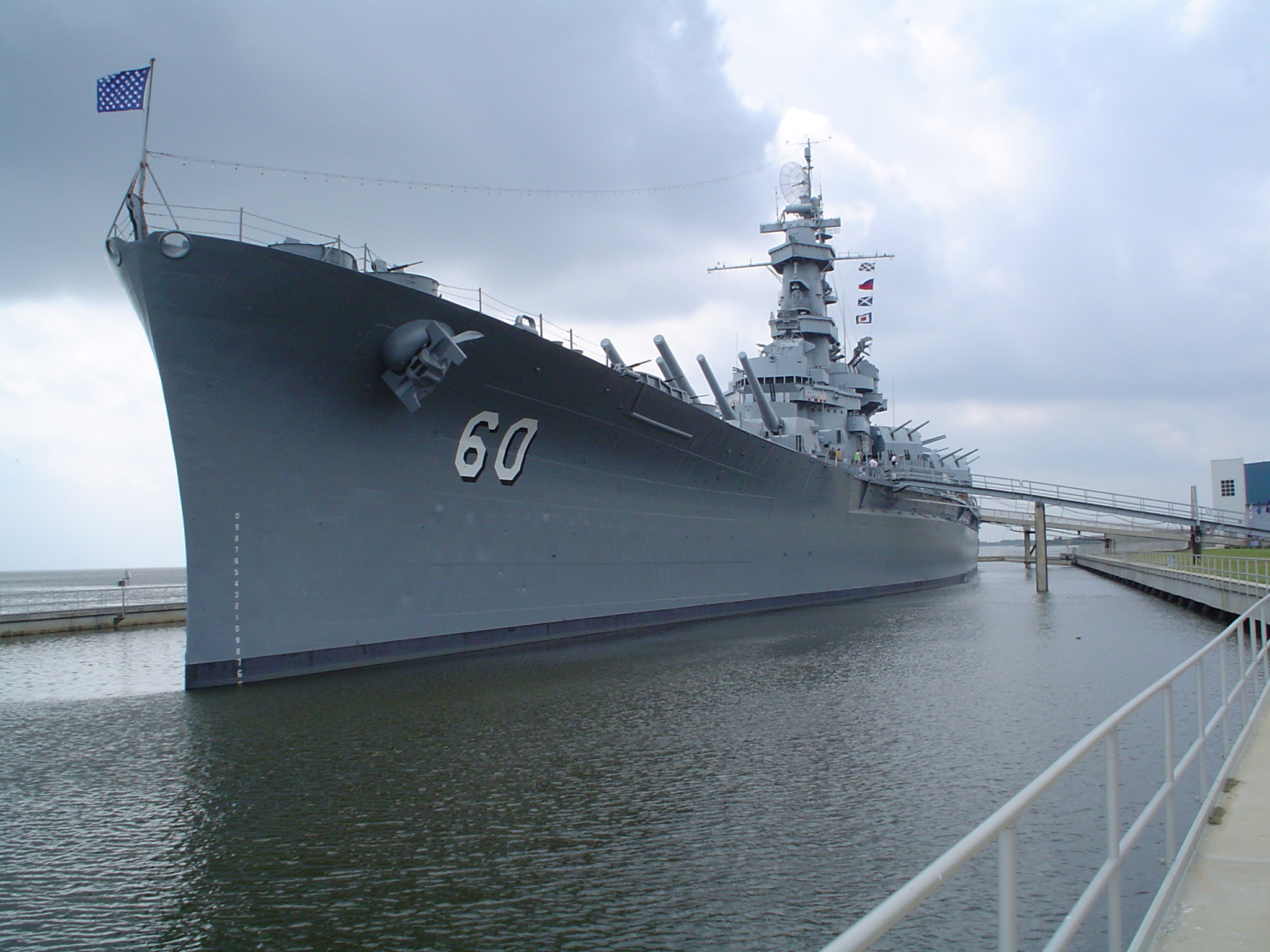
According to Wikipedia, "USS Alabama (BB-60), a South Dakota-class battleship, was the sixth ship of the United States Navy named after the US state of Alabama, Alabama was commissioned in 1942 and served in World War II in the Atlantic and Pacific theaters. She was decommissioned in 1947 and assigned to the reserve duty. She was retired in 1962. In 1964, Alabama was taken to Mobile Bay and opened as a museum ship the following year. The ship was added to the National Historic Landmark registry in 1986." She displaces around 35,000 tons. (Compare this with the displacement of 2,250 tons for my first ship, the USS Hugh Purvis, a destroyer.) The Alabama is just shy of 700 feet log and has a beam of about 100 feet. To a former destroyer sailor, it seems really HUGE.
Mary Ann and I paid our entry fee to the park and proceeded up a ramp to the main deck, still covered with teak, as it was built. We entered the superstructure and Mary Ann decided she would remain above the main deck while I explored. I descended about four decks in the aft part of the ship and saw huge crew bunking areas as well as the service spaces that were needed to care for her 1,800 officers and crew. There was a large barber shop, a tailor shop, and even a cobbler's shop. The brig had for separate cells. The bakery and food preparation areas were enormous. The presentation was beautifully done, with arrows pointing in the direction of self-guided tours, mannikins dressed as crew members carrying out their duties, and an abundance of explanatory plaques and museum displays.
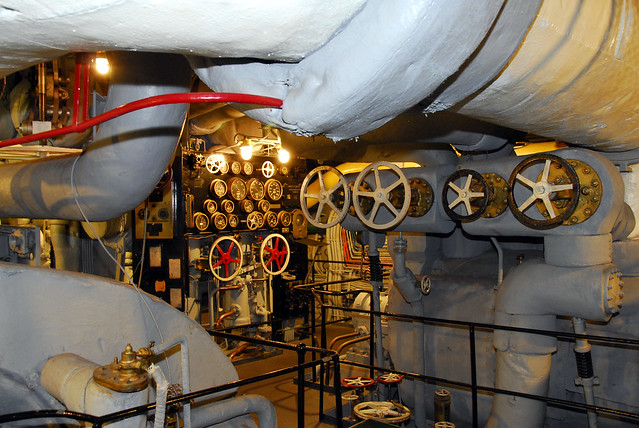 |
| The engine room main control panel |
My interest in this aspect of the ship stems from the fact that I was Main Propulsion Assistant on a destroyer and later the Chief Engineer of a destroyer escort, the USS Maloy. I love ship's machinery! I was not disappointed. The engine rooms are very much intact and available to visitors. I simply had to take a picture of this ID plate on a ship's generator cooling coil made in my home town of Schenectady, N.Y.

After I got my fill of below decks exploring, I rejoined Mary Ann, relaxing in the air-conditioned comfort of the officer's wardroom (dining room to you landlubbers). We proceeded to the aviation museum near the battleship. I half-seriously said to Mary Ann, "Maybe we'll see an F-8 Crusader like my brother flew." Sure enough, in a very nice collection of well-preserved military aircraft, there was an F-8. My brother Bill logged over 2,000 hours in that type of airplane.
 |
| The Chance-Vought F-8 "Crusader" - The plane my brother flew in the 1960's |
 |
| Interior of USS Drum - Tight Quarters! |
Monday morning, we got packed and dressed and proceeded for a late breakfast at a nearby IHOP. When we left Spanish Fort, the GPS said we'd be home by 6:42 PM. We made a few convenience stops and one stop for fuel. Picked up a dinner pizza in Huntsville, and were still at the house right around 7:00. We were tired but happy. It was a most relaxing and enjoyable getaway.
May 19, 2013
Banjo Boys, Chapter 19
This weekend, both Monty and Clint had previous engagements, so I was on my own. The big news this week was that the clear plastic heads for my banjo and Monty's arrived. We ordered these a few months ago but because of their non-standard size (11-5/8", medium crown), they had to be custom made.
 The first job for this weekend was to re-fabricate my tension hoop -- the hoop that is pulled down by all those hooks and stretches the head across the rim. I had already made this hoop, but I made it slightly too small. I bought some more brass to start over. I now have the advantage of having the head to use as the gauge for the size of the hoop. So the first thing I did on Saturday was to fabricate this ring and prepare it for Dan Shady to silver solder the ends together. The ends are cut at an angle as shown to provide a larger surface for the silver solder to adhere to.
As soon as I laid my plastic head in place, I realized that I had a problem. The gap that exists between the Rim and the base of the neck, intended to accommodate the hoop of the head, was too narrow. The edge of the head couldn't slip down into the gap. So I knew that the second job for the weekend was to somehow widen that space.
I removed the neck from the rim. I then drilled a small hole in the dowel rod at exactly the midpoint of the rim (5 13/16" from the base of the neck). This gave me a pivot point from which I needed to deepen the radiused cut that already existed in the bottom of the fretboard. I clamped a board on my drill press that had a nail of the proper diameter to fit in the newly-drilled hole. I then mounted a small sanding drum in the drill press, adjusted the board so that the sanding drum would take a thin slice from the existing arc and swung the neck back and forth across the abrasive surface. I had to repeat this a couple more times, readjusting the position of the board each time. I finally dressed up the bottom edge of the cutout area with some precision chisels. Then I stained the newly-exposed surfaces to match the rest of the neck. I think the result speaks for itself:


 The first job for this weekend was to re-fabricate my tension hoop -- the hoop that is pulled down by all those hooks and stretches the head across the rim. I had already made this hoop, but I made it slightly too small. I bought some more brass to start over. I now have the advantage of having the head to use as the gauge for the size of the hoop. So the first thing I did on Saturday was to fabricate this ring and prepare it for Dan Shady to silver solder the ends together. The ends are cut at an angle as shown to provide a larger surface for the silver solder to adhere to.
As soon as I laid my plastic head in place, I realized that I had a problem. The gap that exists between the Rim and the base of the neck, intended to accommodate the hoop of the head, was too narrow. The edge of the head couldn't slip down into the gap. So I knew that the second job for the weekend was to somehow widen that space.
I removed the neck from the rim. I then drilled a small hole in the dowel rod at exactly the midpoint of the rim (5 13/16" from the base of the neck). This gave me a pivot point from which I needed to deepen the radiused cut that already existed in the bottom of the fretboard. I clamped a board on my drill press that had a nail of the proper diameter to fit in the newly-drilled hole. I then mounted a small sanding drum in the drill press, adjusted the board so that the sanding drum would take a thin slice from the existing arc and swung the neck back and forth across the abrasive surface. I had to repeat this a couple more times, readjusting the position of the board each time. I finally dressed up the bottom edge of the cutout area with some precision chisels. Then I stained the newly-exposed surfaces to match the rest of the neck. I think the result speaks for itself:

So now, I have a banjo with a clear plastic head in need of a tension hoop, to be completed this week. I also need to figure out exactly how I'm going to use my Navy spoons as tension hooks and how I'm going to make the tailpiece out of the meat fork. We're getting close!

Subscribe to:
Posts (Atom)