Nov 3, 2016

What Goes Around Comes Around...

Ingalls Shipbuilding, where I worked from 1972 until 1978
In 1972, I went to work for the Ingalls Shipbuilding Division of Litton Industries in Pascagoula, Mississippi.  I was to remain there as a systems engineer and as a senior project engineer for the next 6 years.  It was a satisfying and exciting place to work.  In 1977, during my tenure there, the shipyard employed over 27,000 people.  It was by far Mississippi's largest employer.

In 2001, Litton Industries was acquired by Northrop Grumman Corporation.  Then, in 2011, Northrop Grumman spun off the shipbuilding sector of its organization, including Ingalls Shipbuilding, into a newly defined company called Huntington Ingalls Industries.  This corporation is now the largest manufacturer of ships for the US Navy, with a backlog of up to $4 billion if options to purchase are exercised.

Yesterday, it was announced that Huntington Ingalls is in the process of acquiring Camber Corporation, my employer for the last 26 years.  Is it not an incredibly small world?  My employee number at Camber is 0005.  I wonder how many digits my new employee number will have if the deal goes through.

Oct 24, 2016

My God!!!! They Have Marshmallow Guns!

A few of our marshmallow guns ready for sale

In February of 2003, it was announced that a very successful woman-owned business in Huntsville, Mevatec Corporation, had been acquired by an aerospace giant, BAE Systems, Inc.  Not long after Mary Ann returned to Huntsville in 2004, she began working at Mevatec during their transition to becoming an integral part of BAE Systems.  Her first job was in a building we fondly referred to as the "Pink Palace," an office building in the Perimeter Corporate Park.  Not long thereafter, she and the rest of the former Mevatec staff were relocated to BAE buildings on Voyager Way in the Cummings Research Park.

Guns in primer getting ready for their
final color coat of paint
Mary Ann is a person who gets involved with causes when she is part of an organization.  She never shies away from responsibility, and her association with the BAE personnel was no different.  It wasn't long before she became part of a fund-raising effort for the American Cancer Society.  BAE had a tradition of holding a monthly fundraising activity, and each department would host the event every so many months.  Soon, it was time for Mary Ann's department to plan the next month's fund raiser.  They decided to do something to benefit the American Cancer Society.  The "something" would be for everyone in the department to make something that could be sold at a lunchtime "show and sell."

Mary Ann and I were discussing what we might contribute when she mentioned a marshmallow gun that we had seen at a craft show a few weeks before and purchased for our grandchildren.  "How hard would it be to make some marshmallow guns?" she asked.  Before I could change my mind, I was in the marshmallow gun manufacturing business.  These were small handheld marshmallow launchers into which you insert a mini-marshmallow and then blow into a mouthpiece.  The marshmallow projectile exits the business end of the gun and can travel 20 or 30 feet.

Some guns in their final white paint
I started an assembly line, pre-cutting specific lengths of 3/4 " PVC pipe, assembling them with elbows and tees, and painting them a variety of colors.  Soon, I was making CIA models, including a "silencer" on the muzzle and painted flat black.  Then there was a hunting model in camouflage paint.  It was a short-lived undertaking, but we made and sold more than 125 "guns" and raised nearly $1,000 for a great cause.

A few weeks after this crazy undertaking, we went to John and Jackie Tidball's Halloween party.  Mary Ann brought one of the marshmallow guns and some "ammunition."  When the guests got hold of the device, marshmallows were flying in all directions!  I tried to pick up as many as I could, but I knew there was some unexploded ordnance left behind.  I ran into Jackie at the grocery store several months later.  She shared that she thought of us often when she found "the little white spots on the floor."  I knew exactly what she meant.

Oct 13, 2016

The Great Columbus Day Car Adventure

A portion of he Flea Market at the AACA Meet in Hershey, PA
The other day, I drove to the credit union to deposit a check, only to find out they were closed for Columbus Day.  It reminded me of a funny incident that took place (Is it possible?!?) forty one years ago this past week.

I had acquired a 1956 Mark II Continental, a very limited-production car, in early 1969, and had driven it as my daily conveyance for over 5 years when I made the decision to part with it.  The car, which I purchased from my brother, had initially been ordered by an attorney from Atlanta, Mr. Gordon Horton.  He had special ordered the car with custom DuPont Lucite Pearl White paint and no external markings.  So serial number C56J-3351 had been delivered to Mr. Horton exactly as ordered in August, 1956.  It had appreciated somewhat since I had purchased it and I was concerned that it might get damaged if I continued to use it as my "daily driver."  I decided to take it to the Fall Meet of the Antique Automobile Club of America (AACA) to be held in Hershey, Pennsylvania, in early October of 1975.  I would drive the car from the Gulf coast, where I was living, to Norman, Oklahoma, where I 
would pick up some parts that I had stored there.  Then I'd proceed to Hershey in this elegant land yacht.  I planned to go by way of Lawrence, Kansas, on my way to Hershey, to visit a young lady I had previously dated in Norman.  The meet itself ran from October 9th through Sunday, the 12th of October.  I planned to arrive in Hershey by Friday evening in hopes that I'd find someone who had sold enough goods that they could rent me their flea market space for a day to sell my car.  The schedule might be a little compressed.  What could possibly go wrong?

A white Continental Mark II, exactly like the one I owned and was selling

I left the Gulf coast on the 6th of October, hoping to get to Norman by early on the 8th.  I'd pick up my parts and proceed to Lawrence for the night, pressing on to Hershey by sometime on Friday, 10 October.  Everything went according to plan until I was somewhere northwest of Baton Rouge, near Krotz Springs on federal highway 71, heading toward Alexandria, LA.   I looked at my instruments and suddenly realized my generator had quit.  It was late afternoon.  The sun was low in the sky.  I continued on, deciding I would go as far as my battery would take me.  Eventually, I had to turn on my headlights.  I pressed on, watching them get dimmer with every passing mile.  I made it as far as Bunkie, LA, little more than a wide spot in the road.  There was an intersection -- where state highway 115 crossed federal highway 71 -- where I finally coasted into a service station with a completely dead battery.  I rolled up to the main door to the service bay.  The owner informed me that he was closing.  He was kind enough to allow me to keep the car parked where it was and attach a battery charger to my battery, running the cables under his closed and locked door.  We figured that if I had a fully-charged battery in the morning, I could probably drive as far as Alexandria, where there might be a parts place that could help me.

Let me describe this intersection in Bunkie at that time.  There was the service station at which I would spend the night.  Next door was a "whites only" dance hall.  Next to that was a black dance hall.  And I recall that there was a liquor store adjacent to or part of one of the dance halls.  There was some celebration going on and there were dozens of cars in the area and a loud dance band playing.  The people outside were dancing and shouting.  Shortly after the service station attendant had left, a local sheriff or deputy showed up to see what I was doing at the closed station.  I showed him the battery charging setup and explained my predicament.  He said not to worry about the crowd.  He was in charge and nobody was going to get out of hand in his jurisdiction.  I decided to try and get some sleep.

Bunkie lies in the middle of a swampy area.  Swamps breed mosquitoes.  The bugs had decided to have a convention in Bunkie that night.  If I left my windows open, I was massacred by hundreds of mosquitoes.  If I closed the windows, I woke up in a pool of sweat.   It became a very long, miserable night.

The sun finally rose a few hours after the revelers had given up.  I started the car successfully,  disconnected the charger, and headed for Alexandria.  I eventually spotted a NAPA store and pulled in just as they were opening.  This is the morning of October 7th.  I soon learned that the Mark II had its own unique generator, a much higher output generator than the standard Lincoln.  They could get one shipped in by the next day, October 8th.  I had no choice but to stay overnight.  The new part arrived at about 10:00 AM.  I always carried a tool kit, and I had the generator and a new fan belt installed by about 1:00 PM.  I got on the road headed for Norman.  After driving a long day (Remember, substantial parts of the Interstate System were still under construction.) I arrived in Norman near midnight.


I slept in the next morning before heading for my "barn" to retrieve the parts I wanted to sell or trade at Hershey.  As it turned out, I wouldn't get on the road 'til late afternoon.  There could be no stop in Lawrence, Kansas, if I was to make it to Hershey on time.  I cancelled that part of my trip, much to the displeasure of my intended hostess.  I made it as far as Effingham, Illinois, a distance of about 600 miles, when I finally threw in the towel.  The next day, the 10th of October, the car and I made it to Harrisburg, PA, another 700 miles.  I was completely exhausted.


I was fortunate enough to find a motel with room available.  After getting cleaned up I went down to the hotel bar to get a sandwich and a beer.  As fate would have it, I struck up a conversation with another car enthusiast.  I explained my mission and he informed me that he had a flea market space available.  I paid him $25.00 for the space for the entire day!

The next morning I drove straight to the flea market space and parked my car.  The car was in place with its signage on display by about 7:30 AM.  I was back on schedule much to my amazement.   The poster on the windshield declared: "1956 Continental Mark II, Approximately 80,000 Miles, Just drove car from Mississippi by way of OKC, $3,600 includes spare A/C compressor and other hard-to-find parts."


A few minutes after 8:00, a gentleman in a white jump suit came by and began looking at the car.  He introduced himself as Mr. Robert Filla.  His business card indicated that he was a vice president of a savings and loan association in Milwaukee.  He was accompanied by two other similarly-dressed colleagues.  He asked if he could examine the trunk.  I already had opened the hood.  He asked if his "body man" could inspect under the car and inside the car.  I agreed, as I had nothing to hide.  This was a very nice example at a reasonable price.  I started the car for him.  His mechanic looked everything over carefully.  Then Mr. Filla asked, "Why is the fellow down the row asking $5,500 for his and you're only asking $3,600?"  I explained that probably the other person didn't really want to sell his car, whereas I fully intended to sell mine.  He further asked what the price would be without the spare parts, and whether I would be willing to drive the car to Milwaukee to deliver it.

We agreed on the following deal:  For $3,600, I would sell him the car, without spare parts and drive it to his business in downtown Milwaukee.  He would buy me an airline ticket to Gulfport, MS.  He would pack and ship the spare parts to my residence in Gautier, MS.  He would write me a check in Hershey which we would cash on Monday when I arrived in Milwaukee.

Mr. Filla gave me the address and phone number of his banker.  I called the poor fellow and woke him up on a Saturday morning to ask about his customer's checking balance.  He asked, "How many cars has he bought?  He put about $75,000 in his checking account yesterday."  I figured I'd take my chances.  So at about 10:00 AM on Saturday, October 11th, I headed off the flea market field on my way to Milwaukee.


Downtown Milwaukee
The trip was uneventful.  I stayed on major highways and arrived at Mr. Filla's building on Monday morning as planned, even parking in one of his reserved spaces in the parking lot under the building.  Soon, I was stepping out of the elevator to greet him and complete the final formalities.  We went into his office, which was lined with photographs of several cars in his large collection.  It was obvious that he was a serious collector.  Immediately, Bob Filla informed me that there was a problem.  Columbus Day was on Sunday, so it was being celebrated on Monday, and the banks were closed.  He did not have enough cash to convert my check into his cash.

We agreed to an alternative plan.  He had raided every petty cash account in the building and had come up with about $800.00.  He gave me that much cash and a check for the balance.  He had already purchased my plane ticket, which was waiting for me at the Northwest Airlines counter at the airport.  I would hold onto the title for the car until his check cleared, at which time I would mail it to him.


The trip to Gulfport was uneventful.  Soon thereafter his check cleared the bank and I mailed off the title, ending my romance with the Mark II.  It had been a wonderful car, but it was time to move on.  Today, that car in comparable condition, is about a $40,000 - $50,000 car.  Ah, well...


Postscript:  I was curious if Mr. Filla had left any "trails" on the Internet, and found the following --

Filla, Robert W.   Bob died Oct. 14, 2008 in Seattle, WA, age 69. He was born in St. Louis, MO, and graduated from St. Louis University, after which he spent 40+ years in the mortgage banking industry. Bob is survived by his loving family: wife Rose, son Tony, daughter Tina, granddaughter Veronica, sister Carol, aunt Jeanette, and many nieces and nephews. After giving up hobbies of cars, boats, and airplanes, Bob studied theology the last 20 years, which he shared with many. In lieu of flowers, donations to a hospice near you. 
Published in Milwaukee Journal Sentinel on Oct. 26, 2008

Oct 4, 2016

The Imperial Convertible...

Yours truly driving the '66 Imperial convertible in 1970.
Photo courtesy of James R. Kahrs, who took it from his 1966 Lincoln Continental convertible.
In 1970, I had returned to school at the University of Oklahoma after fulfilling my obligated service to the U.S. Navy.  I was enrolled in the College of Engineering, working in the Office of Financial Aids 40 hours per week, managing an apartment complex, receiving GI Bill benefits, and serving in the Navy's active reserve.  I don't recall any time during which I had more discretionary income.  And, I was horse trading cars just for the fun of it.

One day, driving on the streets of Norman, Oklahoma, I spotted an Imperial convertible.  I couldn't have told you the model year, but I knew I had never seen one before and that it had to be quite rare.  At the next traffic light, I asked the driver if he might pull over so I could look over his car.  He accommodated me and I got to check out the car and was informed that it was a 1966 model.  It was a stunning powder blue with a white top and white leather upholstery.  It looked pristine and had a little over 66,000 miles on the odometer.


I asked the gentleman if he might consider selling the car.  I'll never forget his response -- "I'd sell my grandmother if the price was right."  He informed me that he'd take $1,100 for the car.  That seemed to me to be in the right ballpark for a four-year-old Imperial.  The next day, the car was mine.

Over the next few weeks, I drove the car quite a bit.  It was quite peppy for such a huge, heavy car, with its 440 cubic inch engine.  It weighed about 5,300 lbs!    I learned that the car had cost well over $6,000 when delivered.  I wrote to the Chrysler Corporation to inquire how many convertibles had been produced in the 1966 model.  I also discovered that this particular Imperial convertible loved to consume oil -- lots of oil.  I had to add a quart of oil about every 100 miles!  It didn't produce any noticeable smoke, nor did it leak any oil in my parking place.  It just consumed massive quantities of engine oil.


One weekend I decided to detail the engine compartment.  As I examined under the hood, I noticed the original Protect-O-Plate.  This was a credit card sized plate that was issued to the original owner and was part of Chrysler's warranty program.  Embossed on the plate was a gentleman's name and the name of a dealer in Kansas City.  I called the information operator in Kansas City and got the person's phone number.

I called the individual whose name was on the warranty plate.  He was surprised to hear from me.  "Where's the car now?"  I told him it was in Norman, Oklahoma.  "Is it still burning a lot of oil?"  I told him it was and that that issue was the reason for my call.  He explained that he bought the car when his son was 16 years old and was learning to drive.  The car had been driven very hard from the day it was delivered and had never been broken in properly.  He complained to the dealer but they knew exactly what had caused the problem.  They wouldn't cover the cost of the needed engine rebuild because the car had been subjected to "racing events."  I had my answer.


I drove the car for a few more weeks while I priced the components I would need to rebuild the engine.  1966 was the first year of the 440 engine, and Chrysler really liked their parts.  Pistons were $30 apiece, valve assemblies were similarly expensive.  A full gasket set was nearly $100.  I didn't want to put another several hundred dollars into the car.  I decided to sell it.  I advertised it at $1,200.  The first couple to look at it bought it.  I had been totally up front with the oil issue, and even provided them with the price list for the total rebuild of the engine.  They bought it and drove off with smiles on their faces.

A few days after the car had departed, I got an answer from the good folks at Chrysler.  There had been only 514 of these cars produced.  This had been the rarest car I had ever owned.  I have often thought back, wondering if I had made a mistake.  Oh, well.  The memories are almost always sweeter than the reality.

Sep 8, 2016

"Ray" and Rommel...


When I was building Huntsville's first skateboard park in the late 1970's, I hired a local policeman (Let's call him Ray) to be a night security guard when he was off duty.  He had been an early K-9 patrolman, and when his trained patrol dog was ready for retirement, the Huntsville police department had allowed Ray to adopt him as his personal dog.  Ray would bring Rommel to help protect the park at night.

Ray told a story about the dog that I still remember.  He lived in an apartment and had lots of friends.  Some of those friends had been given keys to Ray's apartment over the years.  At some point, Ray began seeing indications that someone had "visited" his place while he was at work.  Certain things would be moved, or items would be missing from the refrigerator.  Little inconveniences, perhaps, but Ray didn't like the idea of someone coming into his apartment when he wasn't there.

Eventually, the invasions got more serious.  At one point, someone short-sheeted his bed.  On another occasion, newspapers were taped over all the windows and most of the kitchen.  This had to stop, and Ray wasn't exactly sure who the culprit was, though he suspected an old girlfriend or one of her cronies.  He came up with an idea.  So, one day he started leaving Rommel in the apartment as a "greeter."

A few days later, Ray came home to find the kitchen door open, and Rommel was sitting at the door, patiently waiting to greet his master.  There were a few shreds of cloth on the floor and a couple drops of blood.  The greeter had done his job.  And Ray had never again had a problem with uninvited visitors.

The other night I met a new member of my men's bible study group.  He was introduced as a retired Huntsville P.D. detective.  I asked him if he had ever known "Ray."  He had indeed.  I told him this story and indicated that Ray had never figured out who the visitor had been.  The gentleman smiled and said, "Oh, I wouldn't be at all surprised if he knew all along who it was."  We had a good laugh at the notion of some poor perpetrator being surprised by that enormous greeter...

Jun 29, 2016

Robert and Ruth L.

I first attended an AA group in Fayetteville, Tennessee, in 1982.  It would be over a year before I would find sobriety.  Nonetheless, I attended meetings at the Fayetteville Group off and on for the next several months.  They met on Tuesday and Friday each week at St. Mary Magdalene Episcopal Church on Washington Street. (At a later date, the meetings changed to Mondays and Thursdays when a couple of members had sons who were playing high school football.  Those games were on Friday nights.)

From the very first time I attended a meeting of this AA group, there were two people who always could be found there.  In the AA meeting, Robert L. was always present, and in the Alanon meeting, which took place at the same time in a different room, you could always find Robert's wife, Ruth.  Not long after I started attending, someone shared with me that Robert had over 33 years of sobriety.  He had gotten sober in 1949.

I simply didn't believe it.  Nobody could possibly call themselves an alcoholic and go 33 years without a drink!  I figured that Robert L. was some kind of a plant or fraud used to lure newcomers into AA by giving them false hope.  I couldn't even imagine the idea of years of sobriety.  It just didn't seem possible.

A few days ago, I looked at a calendar and noticed that I'm only a few weeks from my 33rd AA birthday.  I have a whole different view of the late Robert L.  I believe he had over 40 years' sobriety when he passed away.  He and his beautiful wife kept the flame of love and hope burning for many years in the little AA group in Fayetteville.  God bless them both.

Jun 24, 2016

A Restoration Excursion...

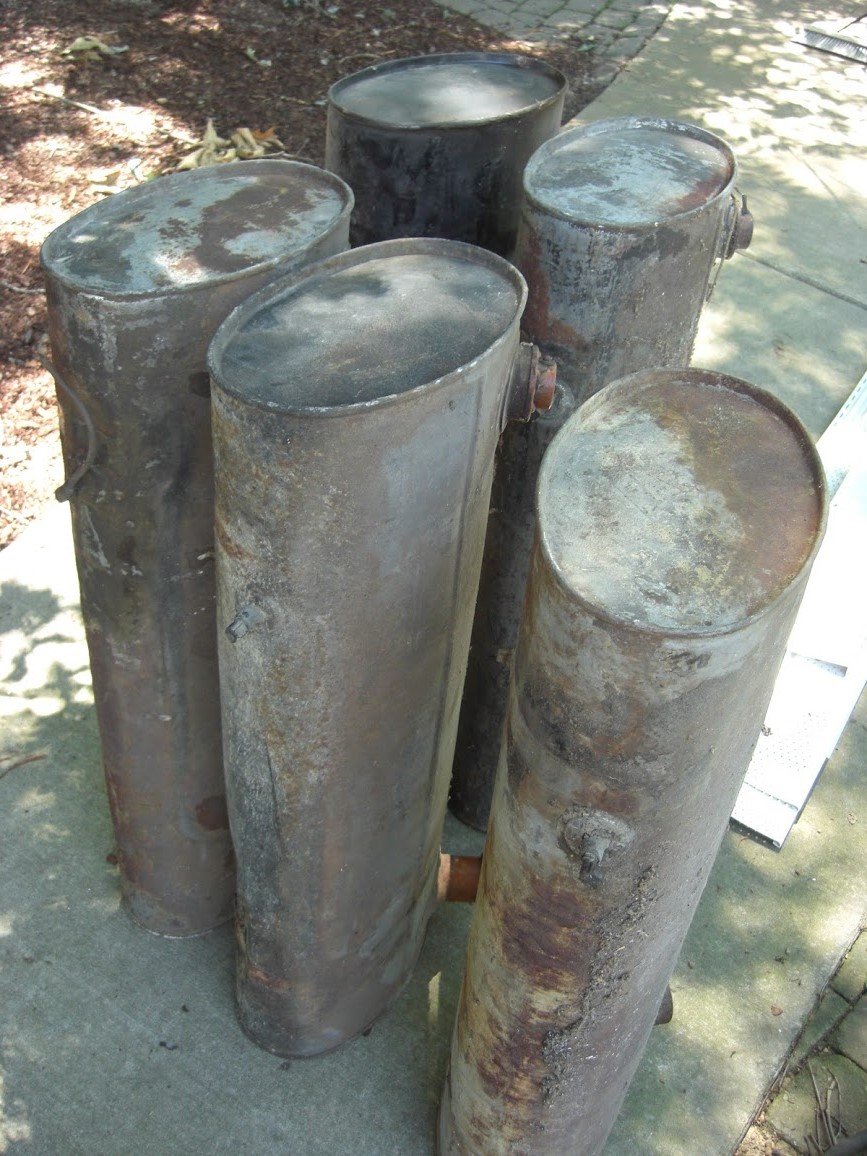
You need gas tanks?  We got gas tanks!
In the Fall of 1997, I was working in San Antonio, Texas, opening a new office for my employer.  I was also embarking on the restoration of my 1932 Plymouth coupe to have it ready to compete in the 1998 Great American Race.  I had no idea what parts I might need, so I was in a general search mode, seeking any information that I could find on spare parts.  One day, while using the search engine Alta Vista, I ran across a posting that a gentleman outside of St. Louis, Missouri, was in the process of dismantling a 1932 Model PB Plymouth to create a hot rod.  He wanted to sell all the parts he didn't intend to use -- engine, transmission, front and rear suspension, wheels, steering column, radiator, gas tank, etc.  I immediately contacted the fellow and offered him $1,000 for the whole lot.  He immediately accepted.  I had my truck in San Antonio and was planning to drive home for Thanksgiving break.  What could be simpler -- merely go home by way of St. Louis!

I told Margo about the find and about my planned expedition.  She immediately suggested that she fly to San Antonio a few days before my planned departure, and that we make a mini-vacation out of the trip.  She came to San Antonio and around the 20th of November, we headed for St. Louis.  We arrived a couple days later at the gent's house.  He had an extremely steep concrete driveway and I backed down to his garage entrance wondering if I'd ever be able to get out without a tow truck.


He came out, introduced himself, and opened his garage door to reveal my treasure.  His very nice '32 Plymouth sedan sat on jack stands on one side of the shop.  My pile of parts was on the other side.  All he intended to use were the frame and body and interior.  Everything else would go.  We spent the next couple of hours loading this massive quantity of parts into the truck's bed.  It looked like a gypsy wagon when we finished, but amazingly, it all fit -- wheels, axles, and all.
Margo and Batty the Wonder Dog proudly display a truckload of Plymouth parts during our first Great Race.
The trip to St, Louis yielded a load bigger than this!
As I got in the cab to attempt the ascent up the driveway, he suddenly said, "Hey, I almost forgot to mention.  I bought my car from a doctor in York, Pennsylvania.  He said he had a couple more engines that were part of the deal.  Since I have no use for them, you can have them if you don't mind going that far to pick them up.  I can just call him and explain that you're going to pick up "my" engines."   This obviously called for another "expedition."

As it turned out, Margo had been planning for us to go to Ohio at Christmas to spend Christmas day with her good friend, Pam Chismar, and her family.  What could be simpler than to follow this up with a short jaunt across Pennsylvania to pick up a couple engines.  To make things even more interesting, my new Hemmings Motor News had arrived when we got in from St. Louis.  I found an ad for some free Model PB Plymouth parts outside of Pittsburgh and immediately called the owner and committed to picking them up.  This stash included a gas tank, front axle, and rear end.


We went to Pam's for Christmas, driving an empty pickup, except for the pulleys and ropes I had brought to maneuver some 600-lb. engines into my truck.  The day after Christmas, we proceeded to Pittsburgh where we met my new best friend and picked up the parts we had been promised.  It turned out that this fellow was a Chrysler restorer who had acquired these parts in a swap deal and had no use for them.  He was glad to see them fall into the hands of a Plymouth restorer.

We left Pittsburgh, headed for York and arrived at our Motel well after dark.  I called the doctor, with whom I had made prior arrangements, to get directions to his place (remember, this is pre-GPS travel).  The next morning, Margo was in terrible shape with a flu-like ailment.  She remained in the Motel, while I went to a lumber yard to buy a couple 2 x 12's to make into a ramp and proceeded to the doctor's barn.  It had started snowing hard.  I entered the barn, searched every room, and found no parts.  I was heartbroken.  I finally decided to call the doctor again to confirm the location.  This barn was one in which the rear of the barn abutted a berm that ascended to what amounted to the second floor.  He informed me that I needed to drive around to the rear of the barn and up the berm to the rear door.  There I would find the engines.


I drove to the rear and had a terrible time ascending the slope because by now there were a couple of inches of snow on the ground.  Finally, with a running start in reverse, I made it to the top of the berm, since I wanted the bed of the truck facing the door.  Over the next couple of hours, I dragged and winched three engines, in various states of completeness, into my truck.  I lashed everything down and headed down the slope.  Soon I was on a paved highway, but the snow was really building up.

The view on I-81
After returning to the motel and listening to a weather report, Margo and I decided to head south to try and beat the arriving blizzard.  We went by a pharmacy and got her some cough and cold medication and headed west to get to Interstate 81.  As we drove south, conditions deteriorated.  Traffic slowed due to the icy conditions.  By nightfall, we heard many reports of road closures.  We got off the interstate at Wytheville and fortunately found a motel with an available room.  By morning, the interstate was completely shut down.  We got Margo to a local doctor for some treatment better than over-the-counter.  The next day, we headed south again and made it all the way home.

Fast forward to 2016:  I have saved those rare 80-year old engines for the last 19 years.  I built small wooden dollies on which each one rests, so that I can conveniently move them about my shop.  They are in exactly the condition they were in when I acquired them, always having been stored inside.

A fairly incomplete engine

A fairly complete engine
 Last Monday, I had a "hit" on my Google Alert for the term "1932 Plymouth."  It turned out to be a Craigslist ad from Long Island, New York, that stated, "WANTED 1932 Plymouth Roadster Engine WANTED, Please email me if you are looking to sell."  I immediately contacted the owner.  It seems that his son was driving the car and threw a rod which punctured the side of the engine block.  Not good.  We're currently working out a deal, determining which engine makes the most sense for him, agreeing on an appropriate price, and figuring out the best way to ship the engine to Long Island.

Who knows -- I may start recouping some of the costs of that memorable winter trip...


And below is the car that needs a new "heart:"