I suppose this vacation really began the first time I encountered the Dry Branch Fire Squad on YouTube. That occurred when I was working at Sikorsky Aircraft in 2006. I fell in love with their music. And eventually I figured out that they put on their own music festival, the Grey Fox Festival, held each year in July in upstate New York. Several months ago, I mentioned to Mary Ann that I'd love to go to that festival some time. Before long, we were planning a trip to upstate New York centered around the festival. We got airline tickets using frequent flyer miles. Mary Ann found a rental cottage very close to the music venue. We reserved a rental car for the week. We even planned to go into New York City one day to attend a play and go to a nice restaurant. Everything was falling into place.
We were scheduled to travel to Albany on Sunday, July 14. As we left for the airport that morning, we had two large suitcases, each weighing in at nearly (but not over!) 50 pounds.
 |
| The Cartilator at the World's Largest Wal-Mart! |
We also had carry-on bags with our personal items, medicines, iPad and computer. We were ready! And everything ran on time. We arrived in Albany in late afternoon, installed the GPS in the rental car (Hyundai Sonata -- surprisingly nice!) and headed out to find a Wal-Mart to stock up on groceries. What we encountered was the the largest Walmart in the U.S, . covering 260,000 square feet and two floors, located in Crossgates Commons in Albany, New York. They had escalators between the two floors and a "cartilator" to move the carts up and down. You put your cart on this gizmo, get on the escalator, and your cart arrives shortly after you step off the escalator. It's magic!
Thank goodness for GPS. By the time we had gotten our groceries, it was getting dark. I programmed the GPS with the address of the cottage. We headed in the general direction of Oak Hill, New York, population 376. The roads in upstate New York follow the contours of the land. These roads evolved from horse paths and carriageways. They don't go in a straight line. We wound our way on ever smaller roads, eventually lacking even a stripe. But the trusted GPS got us to the rented cottage. We unpacked the necessities, got the groceries stowed, fired up the small air conditioner, and retired for the night.

I had noticed when we entered the cottage that it smelled as though it had been smoked in. That was a warning sign. By morning, Mary Ann was having difficulty breathing. She was having an allergic reaction to something in the cottage. We didn't take time to figure out what the allergen might have been. We packed our stuff, loaded the car, left a message for the landlady, and headed back to Albany to find a more suitable accommodation. On the way, we drove by the site of the music festival to make sure we could find it later in the week. The place was a bustle of activity, with staff and volunteers putting the finishing touches on months of preparation. We ended up at a Marriott Courtyard in the medical district, close to the interstate, clean, and non-allergenic. Problem solved.
We had finished our relocation by late morning, so we went out to find some lunch. Using Urban Spoon as our guide, we happened upon Delma's Diner. What a great surprise. I later wrote a review on Urban Spoon that tells the story: "While on a vacation in upstate New York, my wife and I found Delma's Diner because it was fairly close to our hotel. We encountered Becky, the world's greatest greeter and server. She alone would have made this a memorable meal. But wait, there's more! The food was terrific. First of all the menu is gargantuan, with Greek, Italian, Mexican, and American selections. Over the next several days, we returned 5 more times and never ordered the same items. Everything was exquisite, with generous portions of very good food. I only wish Delma's were closer to my home! Give this place a definite Thumb Up! (Try the Reuben; you won't regret it.)"
After leaving the diner, I suggested we try to find the USS Slater, a World War II Destroyer Escort. I served on a similar ship in 1964-65 and have known about the Slater for many years. It is on the National Registry of Historic Sites and is open to the public as a museum ship. Most impressively, it is the last ship of this class remaining afloat. The hulls of the DE's, built for a maximum of a couple years of service, are only 3/8" thick. It's quite remarkable that this ship, launched in 1944 (She'll be 70 next year.) is still intact.
 |
| USS Slater (DE-766) -- Afloat in Albany |
Again, using the GPS, we found the museum ship. Mary Ann stayed in the air-conditioned car while I approached the ship. The signage indicated that it was only open to the public Wednesday through Sunday. Nonetheless, I went into a "ship's store" on the pier and spoke with a young lady, explaining that I had served aboard a similar DE. She informed me that I could go aboard and she summoned Tim Rizzuto, the Executive Director of the Museum Foundation that operates the site and coordinates restoration efforts. Tim was there in a flash, introduced himself and said I could have the run of the ship but asked me to be careful as I wandered through the vessel. There were several people engaged in restoration work evident as I walked aboard. I mentioned to Tim that I had been Chief Engineer and Executive Officer of the USS Maloy (DE-791), so he immediately
 |
| A volunteer working on a Slater main engine |
recruited one of the engineering restorers to escort me belowdecks. Over the next couple of hours, I received the grand tour. The restoration work, done completely by volunteers, is remarkable. I met one gentleman, Clark Farnsworth, who has been working on the ship every week for the last 13 years. He is 91 years young! They have a very dedicated robust volunteer organization. It was a wonderful experience, visiting a ship that brought back many fond memories. I appreciate the efforts of these hard-working volunteers.
After we bid farewell to the Slater, we drove to Schenectady, the city I was born and raised in. It's only about 15 miles from Albany. We first drove to 849 Union Street to see the house where I was raised. Mary Ann had never been to upstate New York, so I wanted to share the Schenectady scene with her. The old homestead looked better than the last time I saw it, but still is in need of some serious TLC. It currently serves as a children's counseling center. It's hard for me to realize that the house, completed in 1902, is well over 100 years
 |
| St. John's Church |
old. We drove around the neighborhood as I pointed out where several of my friends lived, where I pumped gas as a kid, some of the architectural highlights, etc. We then proceeded to the Church of St. John the Evangelist.
St. John's was the church that dominated my early life. We lived only a couple blocks away, so I went to Mass there, attended the school, served as an altar boy, sang in the choir, and was a member of the boy scout troop. The building dominates the neighborhood. Much to my disappointment, as I attempted to take Mary Ann into the church to show her its spectacular interior, I discovered that the building was locked! I guess it's a sad commentary on the state of our society that we have to lock a place of worship. We moved on.
Union College (now Union University) is directly across the street from St. John's church. We drove through the Payne Gate (named for John Howard Payne, who wrote "Home Sweet Home") and cruised around the formerly all-men's campus. This was my childhood playground, as it was one short block from my home. I pointed out a few of the academic buildings and some of the fraternity houses. This short tour brought us to the GE Realty
 |
| Homes in the GE plot |
Plot. This unique neighborhood is well described in Wikipedia: "Originally an undeveloped tract owned by the college, it was sold to General Electric (GE) at the end of the 19th century to help the college pay off a debt. The company's executives subdivided it, laid out streets according to a plan inspired by New York's Central Park and built houses on the land, with covenants requiring a minimum lot size and house value. Two of them were among the first fully electric houses in the U.S., used as models by GE. Also settling in the neighborhood were some local businessmen and politicians, and the research scientists who worked at the company's research laboratory a short distance away. They were collectively responsible for over 400 patents. Some of the key events in their research happened within the Plot, as many took things home to work on."
 |
| The Stockade District |
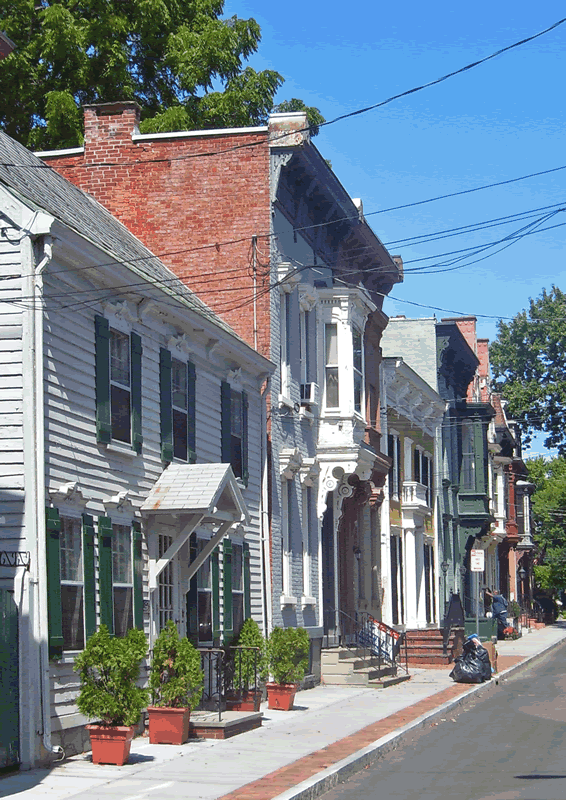
The next stop was the Stockade District, a section of Schenectady rebuilt shortly after the village was burned by the Iroquois in 1698. Many of the old buildings, some over 300 years old, are still being lived in. We drove through the area and then along Front Street to see if my youthful "Watering Hole" was still there. It is and is apparently thriving. Then we proceeded to the Mont Pleasant area of town to visit the site of my high school which looked exactly as I remembered it. Enough of the old home town. We returned to Albany for a quiet dinner and much-needed rest.
Tuesday we had decided would be the day to visit Lake George
and other sites to the north of Albany.
From 1940 until 1948, my family spent the month of August in a rented cottage
on Basin Bay at Lake George. I wanted to
show Mary Ann the Adirondack Mountains and there’s no better way to do it than
to drive through them.
 |
| The Grandstand and Clubhouse at Saratoga Racetrack |
We left Albany
around ten o’clock and headed to Saratoga Springs.
This year marks the 150th season of horse racing at Saratoga
and the season was scheduled to open the next Saturday after our visit. We drove to the Visitor’s Center in the
central shopping area and got some maps and information. We drove around town to look at many of the
spectacular old homes (There was lots of money in Saratoga!). Looking for a place to eat, we bypassed a little sandwich shop that had no air conditioning, drove to a place that
was closed, and finally settled on Shirley’s Restaurant. We had a decent, but not great, meal.
We headed back into town to drive around the neighborhood of the race
track. I wanted Mary Ann to have an
opportunity to see the clubhouse, built in the 19th century. We drove around the area of the track,
bustling with activity – dozens of trucks and horse trailers, horses on the
training tracks, groundskeepers at work, and plenty of spectators there to take
in the proceedings. Once we had seen the
sights we got back on Interstate 87, the “Adirondack Northway,” and headed for
Lake George.
 |
A cottage similar to the one
my family rented on Basin Bay |
We exited just south of
Lake George Village and drove north on Route 9N, a 2-lane mainstay also known
as Lake Shore Drive. I was looking for
the road that would turn off to the right and go by the house my family used to
rent. I asked Mary Ann to be on the
lookout for “Basin Bay Road,” hoping there might be a marker. We passed a number of vaguely familiar
landmarks – Trinity Rock, Still Bay, The Moorings, the Lake George Club, and
Diamond Point. I finally said, “It’s got
to be along here somewhere. It might be
called ‘Cotton Point Road,’” remembering the name of the point that defined
Basin Bay. Within a few hundred yards, I
made a sharp turn onto Cotton Point Road.
I’m sure I scared the driver who was tailgating us. We drove along the edge of the bay and it looked
exactly as I remember it from the 1940’s.
I pointed out to Mary Ann the cabin that I believe we knew as “The
Birches.” We turned around and headed
back north to the small settlement of Bolton Landing.
 |
| The spectacular Sagamore Hotel in Bolton Landing |
Bolton Landing was where we grocery shopped and picked up
our mail when we lived at the lake. It’s
grown but still looks like a lazy tourist town.
We spied an ice cream store, parked and went inside for a cooling break. As we sat eating our ice cream cones, we
overheard a family next to us talking about Fort Ticonderoga. Mary Ann asked how far that was. We concluded that it was about 40 miles
north, so of course we decided to go there.
We continued on Route 9N past the Sagamore Hotel, a stunning Victorian
landmark that was, during the 1920s, ‘30s, and ‘40s, the Jewish hotel at a time
when anti-Jewish prejudice was alive and well in upstate New York.
 |
| The Inn at the Silver Bay retreat |
We drove north past the uphill side of rattlesnake-infested
Tongue Mountain, past Sabbath Day Point (what a great name!), and Bass
Bay. I turned right on the road to the
“Silver Bay Association” just to show this place to Mary Ann. According to Wikipedia, it began as a
farmhouse, and in the 1890s it was expanded and became a lodge capable of
supporting 80-100 people. In 1897, Silas Paine, a Standard Oil
executive, vacationed at the resort and decided to buy a portion of land
adjacent to the property. By 1898, Silas
had a large resort addition linked to the original house, and during 1900 and 1901
he added several cottages to the complex. The structure was bought by the YMCA in 1904,
and assumed its final, well-preserved form during expansions between 1925 and 1926
under the supervision of architect William E. Clark. The complex was listed on the National
Register of Historic Places in 1980.
We continued north toward Ticonderoga, passing The Hague and
the Roger’s Rock Campground.
Unfortunately, we arrived at the site of Fort Ticonderoga too late to
take the tour. They had closed their
gates for the day. I suggested we take a
different, somewhat straighter, more direct route back to Albany – Route 22,
which coincidentally goes through Whitehall, New York, the city where my
mother’s family lived. I had never
driven this section of Route 22 before, but as I tried to picture where I was
in relation to Whitehall, it dawned on me that we would be driving right past
the farmhouse where my great uncle Robert Neddo (after whom I’m named) had
lived. The GPS helped me realize when we
were approaching the South Bay of Lake Champlain, and sure enough, there was
Uncle Bob’s house.
 |
| The sign on the Neddo Cemetery |
I asked Mary Ann to watch out for Neddo Street as we
approached Whitehall. I thought that the
Neddo family cemetery was on that street, and I wanted to take some pictures of
gravestones as part of my genealogical research. We spotted Neddo Street, found the family
graveyard, which was unlocked, and I got my pictures. We continued on without much excitement all
the way to Albany, had dinner, and found our hotel, tired but having enjoyed a
busy day. We took time to drive to the
railroad station to extend our tickets from Hudson, New York, to Albany, since
we had originally planned to catch the train at Hudson. It also gave us an opportunity to reconnoiter
the parking situation at the Albany Amtrak station in preparation for
Wednesday’s excursion into the Big Apple.
Wednesday we arose early in order to be at the Rensselaer/Albany
Amtrak station by 7:45 to catch the 8:20 train to Penn Station. This adventure had started a few weeks before
when I learned of a play telling the story of the founding of Alcoholics
Anonymous. I had forwarded the
information to Mary Ann. She had called
me at work a week ago reminding me that the play, Bill W. and Dr. Bob, was
going to be playing in an off-Broadway theater while we were in upstate New
York. We decided to get tickets, take
the train to the big city, go to the performance, and have a nice dinner before
returning to the capital district.
 |
| Amtrak along the old "Water-level Route" |
Our train left right on time. It was clean, modern, and comfortable. Amtrak uses the rails formerly owned by the
New York Central System on this route.
It used to be advertised as the “Water-Level Route.” It follows the eastern shore of the Hudson
River as it winds its way between New York City and Albany. The views are delightful. I was able to follow our progress using the
GPS function on my iPhone. Acting as
tour guide, I’d let Mary Ann know of every upcoming feature in the river or
place of interest. In a little over 2
hours, we arrived at Penn Station.
 |
San Marino's Breakfast Room,
where we enjoyed a cool lunch |
Descending into the subway lines below Penn Station, we
caught the E train southbound to Spring Street.
When we rose to street level, it was as if we were hit by a blast
furnace. The heat index at the street
was well over 100 degrees. We could see
the SoHo Playhouse from the point where we emerged from the subway, but we were
two hours early for the show. I had
researched the local restaurants and suggested we walk around the corner to the
San Marino for lunch. We found it with
no trouble and entered the cool relief of air conditioned space. We were greeted and seated by Miguel, a gentleman who
clearly has several years’ experience in the food service industry. He was an extremely gracious host and made
sure that we did not feel in the least bit rushed. We enjoyed a pleasant, leisurely lunch and
remained in the Mediterranean environment of San Marino until show time.
 |
| The cast of "Bill W and Dr. Bob" |
We quickly walked around the corner and into
the theater. The SoHo Playhouse seats
exactly 168 people. It is small enough
that you feel as if you are immersed in the drama on stage. It was easy to hear every spoken word. And the play was extremely moving – well-written,
historically accurate, and very well performed.
Both Mary Ann and I were glad we got to see it.
We decided to return to Albany immediately rather than
remain in the city to have dinner. The
heat was having an adverse effect on Mary Ann’s breathing and we felt that it
was best to get her into an air-conditioned environment as soon as
possible. We took the subway to Penn
Station, got our tickets changed to an earlier train, and were soon on our way
back north. We arrived in Albany around
8:00 PM and found a wonderful Iberian restaurant called Barcelona, where we
enjoyed a memorable dinner. We returned
to our hotel and didn’t set an alarm.
We awoke Thursday morning, turned on the news, and realized
it was going to be another scorcher.
This was a disappointment. We had
planned a vacation in the north so we might enjoy some cooler weather. Mary Ann is sensitive to the heat. And here we were, right in the middle of the
worst heat wave upstate New York had seen in 11 years! Mary Ann was still feeling the effects of
yesterday’s activities and heat and dust and car fumes and God knows what
all. She indicated that she’d like to
take a day of rest to recuperate, but told me that if I wanted to go somewhere
and do something by myself, that would be perfectly fine. In fact, one of the things I’ve talked about
for years is to go to some of the roots locations of my ancestors to do some
genealogical research and fill in some blanks in my family tree.
I got on line and found the phone number of the
Whitehall Historical Society in Whitehall, N.Y. I called and made arrangements to meet the Town
Historian, Ms. Carol Senecal at 10:30 AM at the building where the town
archives are stored, 12 Williams Street.
 |
| The Griswold Library |
I arrived promptly and Ms. Senecal was already there. The archives are upstairs over the Griswold Public Library, housed in a residential building built in 1855 and donated to the library. The newspaper office in Whitehall burned to the ground in 1932, destroying all the archived newspapers. Because of this loss, the historical society has depended heavily on donated scrapbooks that have been meticulously cataloged by volunteers. I looked through 5"x 7" cards that were organized by surname. Under the Neddo name, I might see a card that says "Neddo, Eva - Marriage, 1903, See scrapbook 126, page 60." Ms. Senecal would retrieve the scrapbook stored in an adjacent room and sure enough, on page 60, I would find the newspaper notice I
 |
| The "Irish" church |
was seeking. I had brought my camera and photographed relevant cards and newspaper articles. I spent about three hours on just the Neddo and Archambault names. After a tour of the other rooms and a thorough explanation of how every item was organized, I bid farewell and drove in the direction of the Irish Catholic church.
Whitehall, like many other cities at the turn of the twentieth century, had churches to serve ethnic groups. Whitehall had a predominantly French-Canadian church, the Church of Notre Dame de Victoires. Across town was the predominantly Irish church, Our Lady of Angels. In recent years, the French church was demolished and the two parishes combined. The Irish church has been renamed Our Lady of Hope. I found it open and took some pictures before proceeding up the mountainside overlooking Whitehall to the Skene Manor.
 |
| Skene Manor |
Skene Manor is a Victorian mansion built in the 1870's by New York State Supreme Court Justice Joseph H. Potter. When I was a child, it was a very elegant and expensive restaurant. On rare occasions when we visited relatives in Whitehall, my grandmother would take us kids to lunch at the Manor. It is currently undergoing restoration and is once again serving meals, although I did not go inside. I looked around, took a few pictures, and headed back to Albany to join Mary Ann.
After I returned to the hotel, Mary Ann asked if I might find a drug store and pick up a few items that we needed. I headed out in search of a CVS pharmacy that my faithful Garmin said was nearby. It turned out to have disappeared, but in the course of actually locating a drugstore, I found a large mall that included a movie theater and several nice restaurants. We had actually commented a couple of days before that neither of us had ever eaten at a Cheesecake Factory, and this mall included one of those. I returned to Mary Ann after picking up the odds and ends and duly reported the results of my reconnaissance. We decided that if the heat wave continued, Friday would be a great day for a movie.
Friday dawned with another 95 degree plus forecast. We decided to hang around the room and read for a few hours, then have a nice early dinner at the Cheesecake Factory, followed by the movie World War Z. We did exactly that. The meal was wonderful; the movie not so much.
Saturday was more of the same weatherwise. The news was all about the effects of the heat wave. It was obvious we weren't going to be going to a music festival today. But that wouldn't slow down the Meads! We decided to visit the Albany Institute of Art and History. I have always been a fan of the Hudson River School of 19th century art. According to Wikipedia: " The paintings for which the movement is named depict the Hudson River Valley and the surrounding area, including the Catskill, Adirondack, and the White Mountains; eventually works by the second generation of artists associated with the school expanded to include other locales, like New England and the Maritimes." The Albany Institute holds one of the largest collections of Hudson River school works in the world. In early afternoon, we proceeded downtown and found the gallery. The display of art was breathtaking. One of my favorites was Thomas Cole's Romantic Landscape with Ruined Tower, shown here:
After leaving the Art Institute, we decided to see another movie! We returned to the same cineplex we had been to the previous evening and selected The Heat as our movie fare. This was one of the funniest ("Laugh Out Loud" funny) movies we've seen in years. The plot is summarized in IMDb as, "An uptight FBI Special Agent is paired with a foul-mouthed Boston cop to take down a ruthless drug lord." Sandra Bullock and Melissa McCarthy had us in stitches. Highly recommended for adults. The language is a little too salty for the kids.
Sunday was a very nice day with highs in the upper 80's. We debated driving down to Oak Hill to take in part of the festival (Remember -- the reason we planned this trip?) and decided against it. We decided to go instead back up to Saratoga to visit the very fine automobile museum located in one of the old plants that was used to bottle the natural sparkling water. First, we had to pack. Recently, Mary Ann bought a small, hand-held luggage scale for times like this. After carefully swapping a few items from one bag to the
 |
| One of the beautiful BMWs |
other, we got each one to weigh 49 pounds. The limit without penalty is 50. We had a light breakfast and headed for Saratoga on this beautiful Sunday.
The museum was smaller than I expected with a travelling exhibit on the first floor and part of the permanent collection, "The Cars of New York State," on the second floor. The temporary exhibit was entitled "BMW, the Ultimate Driving Machine." It is a seven-month major exhibition of significant BMW cars and motorcycles from the 1930's to the present. It included BMWs ranging from the sporty pre-War 328 roadster – one of the most successful competitors of its day - to the
 |
| The 1931 Pierce Arrow |
supremely elegant postwar 507, the winged CSL of the 1970's, noted BMW racecars and much more. There were cars from the BMW Museum in Munich and the BMWNA Collection. The 2 wheeled BMW’s were compliments of the Nettesheim Museum in Huntington, NY. They were also quite varied from the first R32, R62, an R12 and many more. The permanent collection included my favorite, a 1931 Pierce Arrow Dual-cowl Phaeton, Charles Lindbergh's 1928 Franklin Airman, a couple of Maxwell's, and a 1947 Playboy. We stayed at the museum a couple of hours and then headed for the airport.
The trip home wasn't quite as pleasant as our earlier flights had been. Because of storms in Atlanta, everything was running late. We got out of Albany about an hour late and the flight from Atlanta to Huntsville was delayed a couple of hours. Nonetheless, we slept at home, very tired, but filled with wonderful memories.
And I've been checking out YouTube videos of the Grey Fox Festival. We would not have survived the intense heat. Maybe some other time.


 We each ordered a pulled pork plate with ribs as our second
meat. This included two sides and a
dessert. We tried the smoked mac and
cheese (honest!) and cole slaw. Mary Ann
had the chocolate pie and I had the peanut butter pie as our desserts. I also got a sampling of their brisket to
try. Everything was very good. The meats were moist and tender. The meat was falling off the ribs. The side orders were tasty, fresh, and
generously served. The desserts, all
home made in house, were wonderful. The
provided sauces were OK, but I prefer a wider variety of sauces than I saw.
We each ordered a pulled pork plate with ribs as our second
meat. This included two sides and a
dessert. We tried the smoked mac and
cheese (honest!) and cole slaw. Mary Ann
had the chocolate pie and I had the peanut butter pie as our desserts. I also got a sampling of their brisket to
try. Everything was very good. The meats were moist and tender. The meat was falling off the ribs. The side orders were tasty, fresh, and
generously served. The desserts, all
home made in house, were wonderful. The
provided sauces were OK, but I prefer a wider variety of sauces than I saw. The young man who waited on us was friendly and very
helpful, recognizing that we were new and not familiar with the menu. While we were eating, one of the owners,
Libby Webb, came by to welcome us and make sure we had gotten everything we
needed. She was bubbly and outgoing and
very enthusiastic.
The young man who waited on us was friendly and very
helpful, recognizing that we were new and not familiar with the menu. While we were eating, one of the owners,
Libby Webb, came by to welcome us and make sure we had gotten everything we
needed. She was bubbly and outgoing and
very enthusiastic.